Spinning up a working demo is easier than it has ever been. A founder can describe an idea, get a clickable app back in an afternoon, and show it to investors by the weekend. The demo looks finished. Then the first real customers arrive, and the cracks show fast. This gap, between something that looks done and something that holds up under real use, is the whole job in SaaS development.
This guide explains what production ready actually means, why prototypes break the moment real users touch them, and what it takes to ship a SaaS platform that survives its own success.
A prototype is not a product
A prototype proves an idea. It shows that the screens make sense and the core feature is worth building. That is valuable, and it is also where its job ends.
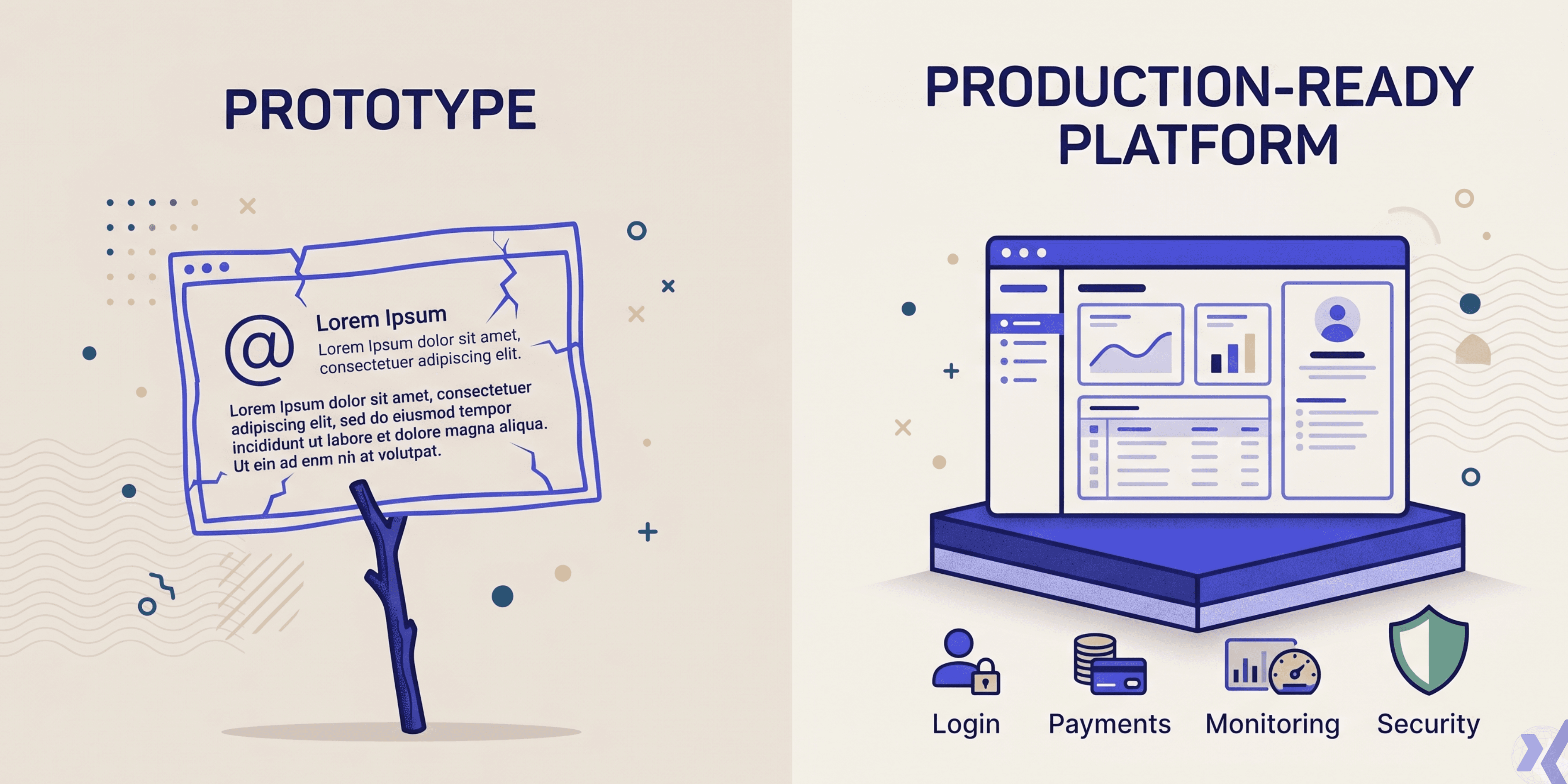
A product has to handle things a prototype never tests: hundreds of users at once, payments that must not fail, data that cannot go missing, and people trying to break in. Most demos skip every one of these, because skipping them is what makes a demo quick. The trouble starts when a business treats the demo as eighty percent finished, when in reality the hard eighty percent has not been built yet.
Why prototypes break in production
The failures are predictable, and they are almost always the same handful:
- No real login system. A demo fakes the user accounts. A product needs secure sign in, password resets, and proper separation between one customer's data and another's.
- Payments that only work once. A demo charges a test card. A product handles failed payments, refunds, tax, and the edge cases that show up the day real money moves.
- No error handling. A demo assumes everything goes right. A product plans for what happens when a service is down or a user does something unexpected.
- Untested at scale. A demo runs fine for one person. A product has to stay fast when a hundred people use it at the same time.
- Security gaps. A demo was never meant to be attacked. A product is, on day one, by automated bots looking for the holes.
None of this is a sign the prototype was bad. It is just a different job, and that job is proper SaaS platform development.
What production ready actually means
A platform is ready for real users when these are in place, not bolted on later:
- Secure login with each customer's data kept separate, the foundation of any full stack web application
- Payments that handle the messy real world cases, not just the happy path
- A database designed so data stays correct even when two things happen at once
- Monitoring that tells you a problem is happening in seconds, not when a customer complains
- Security testing built into the work rather than rushed in at the end
The point is that these are not extras. They are the difference between software that works in a meeting and software that works in production.
What the Australian rules add
A SaaS platform stores customer data, so it sits under the Privacy Act 1988 and the Australian Privacy Principles, which the Office of the Australian Information Commissioner enforces. That shapes real decisions: where the data is hosted, how cross border transfers are handled if you use overseas services, and how you respond under the Notifiable Data Breaches scheme if something goes wrong. For government, defence, and healthcare clients, data sovereignty can require hosting inside Australia. Building these choices in early is far cheaper than retrofitting them after launch.
How to bridge the gap
The fastest path from prototype to product is not to throw the prototype away. It is to treat it as the proof, then build the real version on a foundation that is sound from the first line. A sensible order:
- Lock the decisions that are expensive to change later: the data structure, how the parts talk to each other, the hosting, and the security model.
- Build the core that real users touch every day first, and get it live early so it is tested in the real world.
- Add the rest on top of a foundation that already works, rather than patching a demo.
Done this way, a first real version can be live within weeks, with the parts that matter most already solid.
The short version
A prototype proves the idea. SaaS development is the work of turning that idea into something that handles real users, real payments, and real scale without falling over. The login, the payments, the data integrity, the monitoring, and the security are not finishing touches. They are the job.
If you have a prototype that is getting attention and you want it ready for real customers, you can book an intro call and we will tell you what it takes to get there before any work begins.