What Healthcare Software Development Involves in Australia
Building software for an Australian health practice is not like building software for a shop. The features are the easy part. The hard part is that health data is the most sensitive category of personal information under Australian law, and any system that wants to plug into the national digital health infrastructure has to prove it conforms before it is allowed to connect. We at XpansionIT build custom systems for Australian businesses, and healthcare is the sector where the compliance work shapes the architecture from day one rather than getting bolted on at the end. If you run a practice, or you are a health provider weighing whether to build something of your own, this is what the landscape looks like in 2026.
This is general information about building software, not legal, clinical, or compliance advice. For obligations specific to your practice, take proper advice.
Do Health Practices Need Custom Software?
Most do not. Mainstream practice management systems cover the common ground well, and if your workflow is standard, use one. Custom becomes worthwhile when your model of care is unusual, when you need systems to talk to each other that will not, or when you are building a product for other practices rather than just running your own.
Why This Is Suddenly Moving
Allied health has been the digitally quiet corner of Australian healthcare, and that is changing fast. The Australian Digital Health Agency released a National Allied Health Digital Uplift Plan, and it is targeting a sector of more than 300,000 professionals delivering around 200 million services a year. The Agency has invested over two million dollars, onboarded a set of vendors to build conformant clinical information systems, and has been working to get allied health software with electronic prescribing into the market.
At the same time the legislative floor has risen. Reforms have moved My Health Record toward sharing by default, starting with pathology and diagnostic imaging providers being required to upload results, with scope to widen. Separate reform work has streamlined healthcare identifiers and data sharing. The direction is unmistakable: information is expected to flow between providers, and software that cannot participate is becoming a liability.
The gap this creates is the opportunity. Survey work behind the uplift plan found that while around 70% of allied health professionals recognise the value of accessing health data, actual use and awareness of the core national systems remains low. A lot of practices are running software that was never built to connect.
Conformance Is Not Optional, and It Is Not a Checkbox
Here is the part that surprises people who have built software in other industries. You cannot simply write code that talks to My Health Record. Clinical software has to meet national conformance requirements before it is permitted to connect, and the Digital Health Agency maintains public registers of the products that have demonstrated it, covering My Health Record connections, electronic prescribing, and the Healthcare Identifiers Service.
In practice that means designing to standards rather than to taste. HL7 FHIR is the interoperability baseline the sector is aligning on. Healthcare identifiers underpin accurate patient matching. Clinical terminology comes from national releases that update on a schedule, so your build has to handle ongoing updates rather than treating a data set as fixed. Secure messaging between providers follows its own specifications. None of this is exotic engineering, but all of it has to be planned for, and it is why a generic development shop that has never touched the health sector will underestimate a health project badly.
Security Is the Other Half of the Job
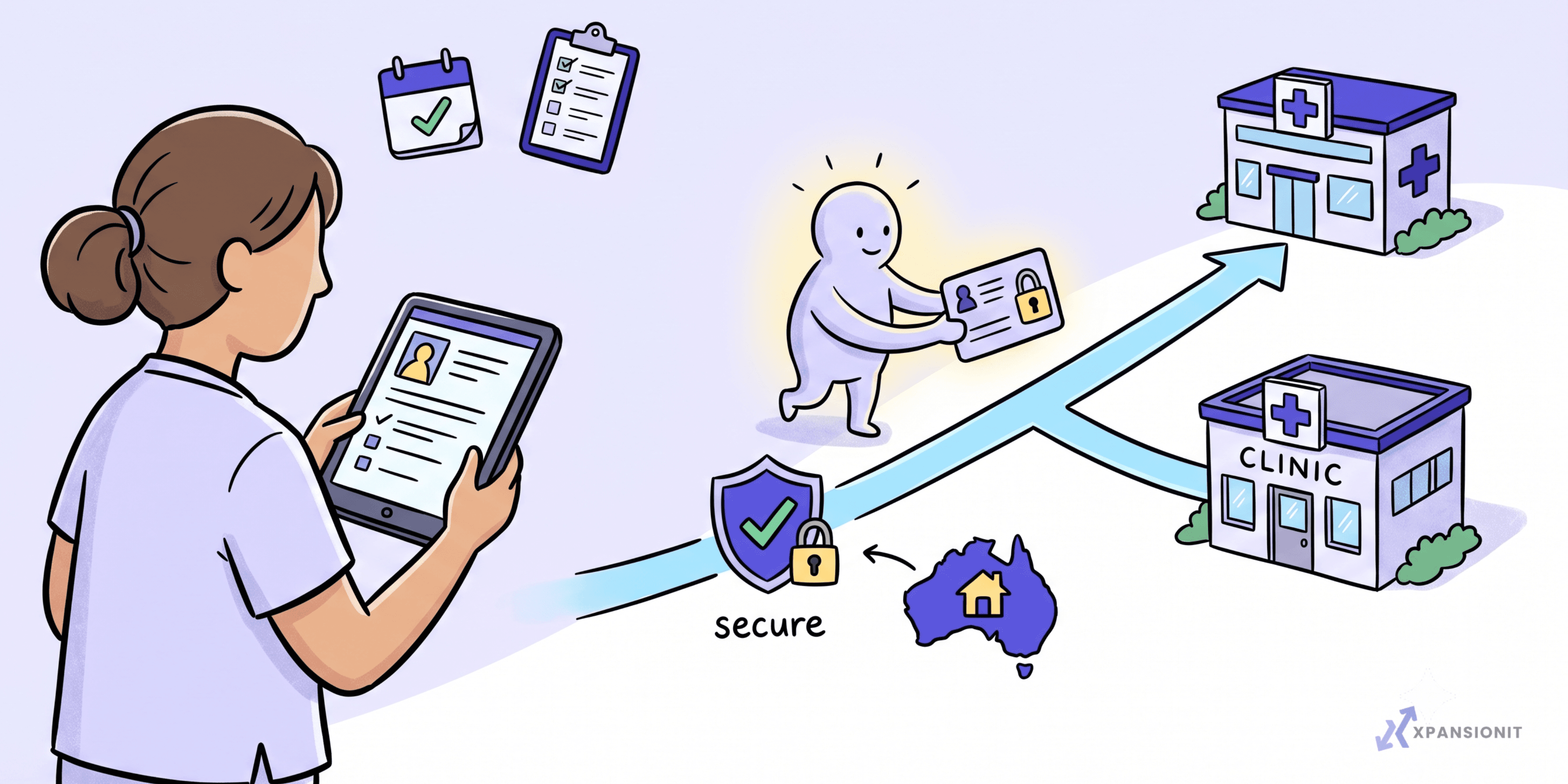
Health information is a sensitive category under the Australian Privacy Principles, and the Privacy Act applies to healthcare providers regardless of turnover, so the small-business exemption that other industries rely on does not help you. The Medibank breach, which exposed data belonging to millions of Australians, is still shaping how regulators and patients think about this.
What that means for a build is concrete. Role-based access mapped to real clinical roles, so a receptionist and a clinician do not see the same thing. Multi-factor authentication on everything that touches patient data, not just email. Audit trails good enough to demonstrate who accessed which record and when, which is a specific expectation for connected providers. Encryption in transit and at rest, and a considered answer to where the data physically lives, because on-shore hosting is often a firm requirement in health. We treat the ACSC Essential Eight as the sensible baseline rather than a stretch goal, and it is the kind of work our compliance and privacy management service exists for.
One more thing worth flagging: if you are building something that makes clinical suggestions, you may be edging into territory regulated as a medical device, which is a different and heavier compliance path. That is a conversation to have early, not after you have built it.
Build, Buy, or Extend
Be honest about which situation you are in, because the answer differs.
If you run a single practice with a fairly standard workflow, buy. The established practice management systems do the job, they already appear on the conformance registers, and building your own would be an expensive way to arrive at the same place. Our guide on the software development options in Australia covers how to think about that choice.
If you have a mainstream system that works but will not talk to the other tools you use, extend rather than replace. Integration work, a patient-facing portal, an automated intake or referral flow, or a reporting layer over data you already hold. This is the most common and most sensible custom project in health, and it usually costs a fraction of a full build.
If your model of care is truly unusual, or you are building a product to sell to other practices, build. That second case is a vertical SaaS play, and health is one of the strongest examples of it, for the same reasons we set out in what vertical SaaS is: deep domain rules, real compliance barriers, and customers that generic tools serve badly. The compliance burden that makes health hard is exactly what protects you once you are in.
Where AI Fits, Carefully
AI is arriving in Australian health, and the useful applications right now are administrative rather than clinical. Converting a consultation into structured notes, drafting referral letters and summaries, triaging inbound enquiries, chasing appointment confirmations to cut no-shows. These save real clinician hours without asking software to make a judgement call.
The line we hold is simple: AI drafts, a registered practitioner reviews and signs off. Anything that shapes a clinical decision needs a human accountable for it, and anything patient-facing needs to be checked before it goes out. Health is also the last place to paste sensitive information into a public AI tool. Doing this properly is what our AI integration work and our thinking on responsible AI in Australia are about.
What It Costs and How Long It Takes
Health projects carry a compliance overhead that other sectors do not, so budget for it properly. A focused integration or a patient portal on top of an existing system typically starts in the low tens of thousands. A full custom clinical or practice platform, especially one that needs to connect to national infrastructure, is a materially larger commitment and takes longer, because conformance and security testing are part of the timeline rather than an afterthought. Our breakdown of what custom software costs in Australia gives the general drivers, and health sits at the more demanding end of every one of them. If a builder quotes a health system without asking about conformance, identifiers, or where the data will live, that quote is not real.
When Not to Build
Since we build software, we could tell every practice it needs its own. It does not. If your current system works, is on the conformance registers, and your frustrations are about training rather than capability, fix the training. If you are a solo practitioner, custom software is almost never the right first spend. And if nobody in your practice can own the project internally, wait, because health builds need a clinical voice in the room throughout, not just at the start. The best outcome we can give some enquiries is telling them to keep what they have.
Why This Matters to Us
We are a small Adelaide team, and health is the sector where we are most careful about what we promise. Getting this wrong does not mean a broken checkout, it means someone's medical history in the wrong hands, or a clinician working from information they cannot trust. We would rather scope a smaller, safer first phase, get the security and the standards right, and earn the bigger build than talk a practice into something ambitious it cannot support. Slow and correct beats fast and sorry in this one.
What Do the Numbers Say?
The pressure and the opportunity are both visible in the numbers: a large workforce, a big gap between recognising the value of connected data and using it, and a market growing quickly.
| What the data shows | Figure |
|---|---|
| Allied health professionals in Australia | over 300,000 |
| Services they deliver each year | around 200 million |
| Allied health professionals who value health data access | about 70% |
| Australian digital health market by 2034 | around USD 31 billion |
A Quick Word From Our Own Playbook
"In health, compliance is not the paperwork you do after building. It is the shape of the thing you build."
Want to know more? Read our guide to taking software from prototype to production.
Talk to Us
If you are weighing up a health software project, whether that is connecting the systems you already run or building something for other practices, we are happy to give you a straight read on scope, cost, and what compliance will add. Call us on +61 420 883 221 or tell us about your practice, and we will tell you plainly if buying off the shelf is the better answer.
Whether it is an integration, a patient portal, or a full platform, we design the security and the standards in from the start and keep a clinical voice in the build. Take a look at everything we do at XpansionIT, get to know who we are, or browse our services. If you are ready to scope something, start with our custom software and SaaS work, our full-stack web applications service, or our compliance and privacy management service, and when you are ready, get in touch.