For years, building a SaaS meant building one tool that almost any business could use: a CRM, a chat app, an invoicing tool. That is horizontal SaaS, and it created some of the biggest software companies in the world. But in 2026 the smart money is moving the other way, toward software built deeply for a single industry. That is vertical SaaS, and the case for it is getting harder to argue with.
The global SaaS market is worth more than $400 billion and is heading past a trillion within a decade, and a growing share of that is industry-specific. This guide explains what vertical SaaS is, how it compares to horizontal SaaS, why it is winning, and how to build one that lasts.
What vertical SaaS is
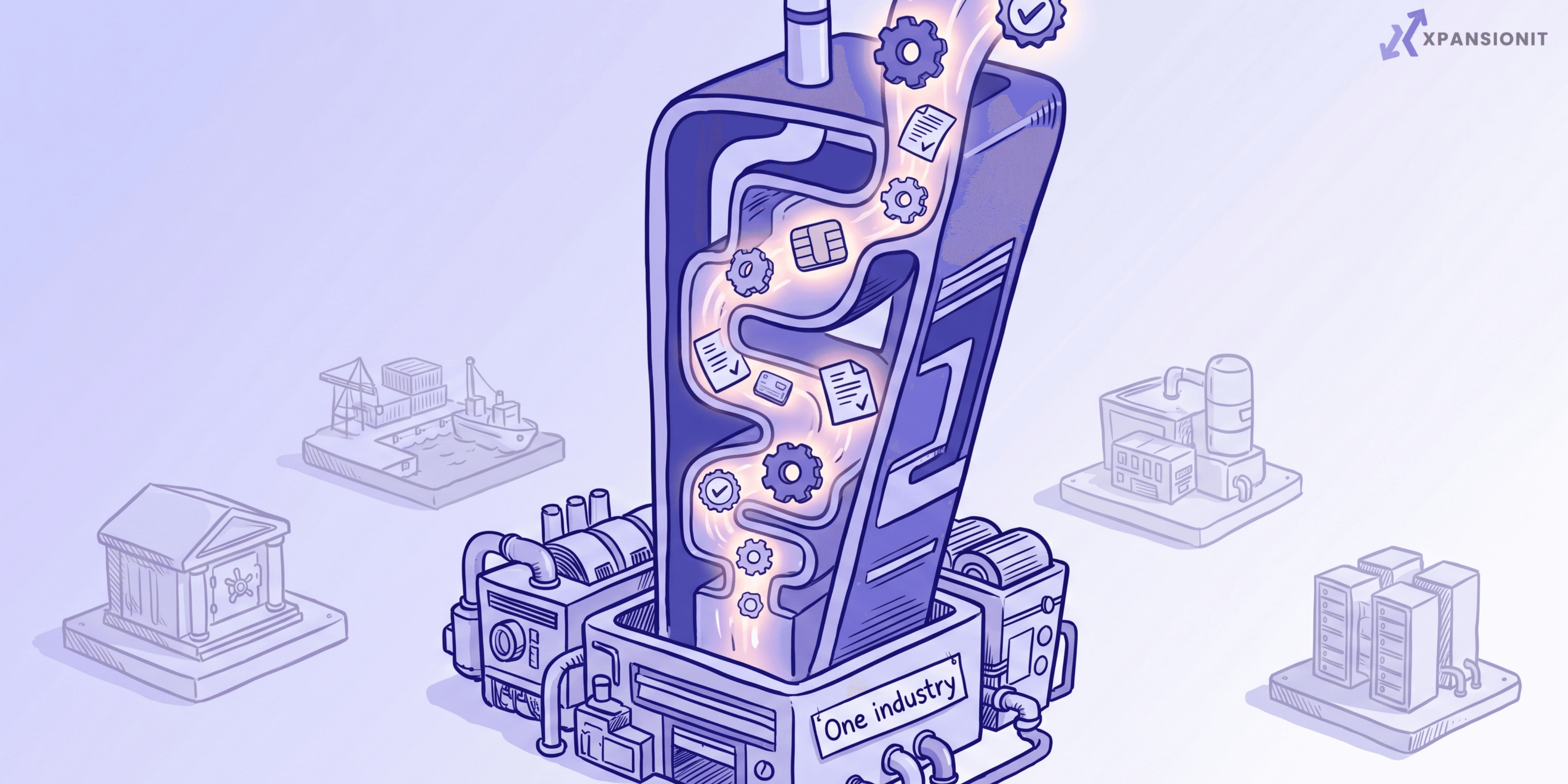
Vertical SaaS is software built for one industry, end to end. Instead of a generic tool that any business can bend to fit, it is shaped around the exact workflow, language, and rules of a single sector: dental clinics, construction firms, law practices, gyms, restaurants, real estate agencies. It does not try to serve everyone. It tries to be the one piece of software a particular kind of business runs on every day.
Compare that to horizontal SaaS, which sells a single capability, messaging, accounting, scheduling, to every industry at once. Horizontal goes wide. Vertical goes deep. A horizontal accounting tool works for a bakery and a law firm. A vertical platform built for law firms handles trust accounting, matter management, and the rules a generic tool was never designed to touch.
Vertical versus horizontal SaaS
The trade-off is breadth against depth.
Horizontal SaaS has the bigger market. Anyone can be a customer, which sounds great until you realise everyone is also competing for them. Win rates are lower, acquisition is expensive, and the product has to stay generic to serve so many use cases, so it fits everyone a little and no one perfectly.
Vertical SaaS has a smaller market but a far better fit. Because it is built for one industry, it speaks the language, handles the compliance, and slots into the exact workflow. That depth makes it sticky. Once a business runs its whole operation on your platform, moving to a generic tool feels like a downgrade. The data supports this: vertical SaaS companies reported a median growth rate of around 31% versus 28% for horizontal peers, with structurally lower churn, because deep workflow integration is hard to walk away from.
Why vertical SaaS is winning in 2026
Several forces have tipped the balance toward going deep.
- Depth creates a moat. A tool built around one industry's daily workflow becomes the system of record for that business. The switching cost is enormous, which keeps churn low and net revenue retention high.
- Less competition. The big horizontal players chase the huge, obvious markets. The narrow, awkward, deeply specific industries get left alone, which is exactly where vertical SaaS thrives.
- Pricing power. Software that solves a painful, industry-specific problem is worth more to the buyer than a generic tool, so it can charge accordingly.
- Industries are communities. Restaurant owners talk to restaurant owners. Builders talk to builders. Word of mouth spreads fast inside a vertical, which lowers the cost of finding new customers.
- Room to expand. Once you own the core workflow, you can add modules: payments, compliance, reporting, scheduling. Many vertical platforms grow by becoming the operational and financial backbone of their industry, not just a single feature.
- AI deepens the moat. Industry-specific AI trained on industry data is something a generic tool cannot match. Around 68% of vertical SaaS vendors now embed AI features, up from 22% in 2023, and investors have followed the trend closely.
The market reflects all of this. The vertical SaaS market is worth roughly $143 billion in 2026 and is forecast to approach $500 billion by 2035, growing faster than the horizontal segment.
What makes a good vertical SaaS
Not every industry is a good target. The strong ones share a few traits.
- A real, painful, industry-specific workflow that generic tools handle badly. If a spreadsheet and three disconnected apps are how the industry currently copes, that is opportunity.
- A market big enough to pay, narrow enough to ignore. Enough businesses in the vertical to build a real company, but niche enough that the giants will not bother.
- Recurring, operational use. The best vertical SaaS is used every day to run the business, not occasionally. Daily use is what makes it stick.
- Compliance or complexity. Industries with regulations, specific reporting, or messy workflows are ideal, because that complexity is precisely what a generic tool cannot handle and what keeps competitors out.
- Domain insight. You, or someone on your team, genuinely understands the industry. This is the single biggest predictor of success, because you cannot fake knowing a sector's real pain.
How to build a vertical SaaS
- Pick the industry, ideally one you know. Domain expertise is the advantage. If you have worked in or closely with a sector, you already know the painful tasks people put up with.
- Find the core workflow. Identify the central process the industry runs on that generic software handles poorly. That workflow is your product's heart.
- Build the system of record, properly. Vertical SaaS only works if it becomes the place the business operates from, which means a real platform with accounts, billing, roles, and data separation on a sound SaaS foundation, built with solid full stack engineering. It has to be reliable, because the business depends on it daily.
- Speak the industry's language. Nail the terminology, the compliance, and the integrations with the other tools that sector already uses. The details are the moat. A generic tool with an industry logo on it is not vertical SaaS.
- Use AI on industry data. Apply AI integration to the specific problems of the vertical. Industry-trained AI is a genuine edge a horizontal competitor cannot easily copy.
- Land, then expand. Win the core workflow first, then add adjacent modules: payments, reporting, compliance, scheduling. Growing revenue from existing customers is cheaper and stickier than always chasing new ones.
The traps to avoid
- A vertical too small to sustain a business. Specific is good. So specific that only a few dozen businesses exist is a hobby, not a market.
- Horizontal in disguise. A generic tool with an industry name slapped on it is not vertical SaaS, and it will not earn the retention that makes the model work.
- Ignoring compliance and integrations. The industry-specific rules and connections are the whole point. Skip them and you have built a generic tool with extra steps.
- Building without domain insight. Guessing at an industry's pain from the outside is the fastest way to build something nobody wants.
A note on going global
One quiet advantage of vertical SaaS is that a workflow tends to look similar across borders. A platform built well for hospitality venues or dental clinics in one country often translates to the same industry elsewhere with modest changes. That makes vertical SaaS a strong base for selling internationally from anywhere, because you are exporting deep knowledge of an industry rather than a generic tool that competes with everyone.
How to start
Start with an industry you understand. Find the daily workflow it runs on that current tools handle badly. Confirm businesses will pay to fix it, then build the platform that becomes their system of record, speaking their language and handling their rules. Win the core workflow, keep customers through depth, and expand from there. That is the entire vertical SaaS playbook.
The short version
Vertical SaaS is software built deeply for one industry instead of broadly for everyone. It is winning in 2026 because depth creates stickiness, faces less competition, and commands better pricing and retention than horizontal tools, while the market grows quickly and AI deepens the moat. Pick an industry you know, build the system of record for its core workflow, and expand from there.
If you have an industry and a painful workflow in mind, you can book an intro call and we will help you scope a vertical product before any work begins.