What an AI Voice Agent Does for Your Business
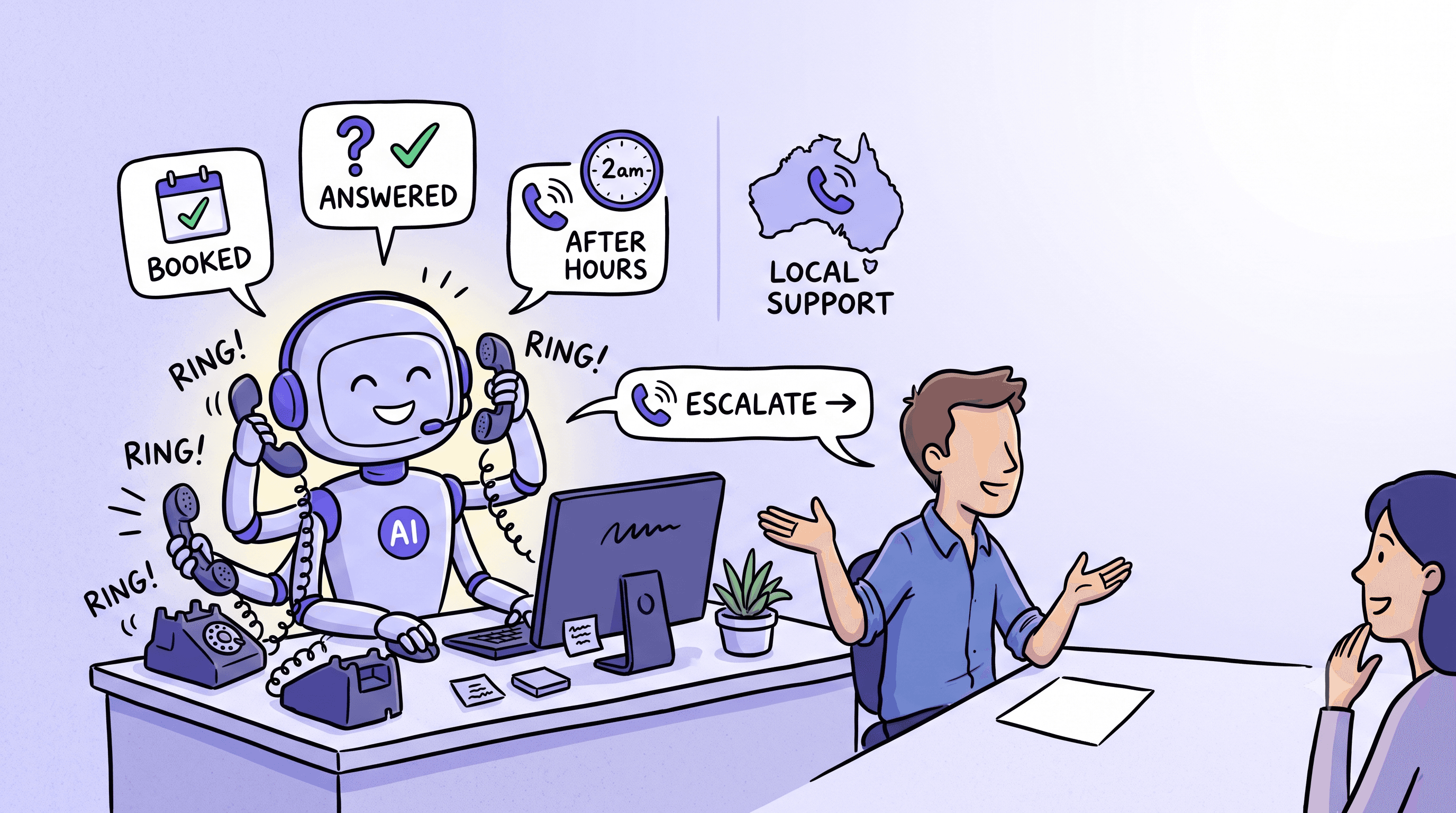
Every missed call is a customer who rang a competitor thirty seconds later. That is the quiet problem AI voice agents solve. An AI voice agent answers your phone in a natural voice, at 2am or during the lunch rush, books the appointment, qualifies the lead, and hands the tricky calls to a human. We at XpansionIT build and integrate these for Australian businesses, and the honest state of play in 2026 is that the technology has stopped being the hard part. A modern voice agent holds a real conversation. Whether it helps you or embarrasses you comes down to how well it is wired into your business, and whether you kept a person where one is needed. Here is how to think about it.
What Is an AI Voice Agent?
It is software that answers or makes phone calls in a natural, human-sounding voice, works out what the caller wants, and acts on it: booking appointments, answering common questions, qualifying leads, or taking a message. Unlike the old phone menu, it holds a real conversation and passes anything complex to a person.
Why the Phone Is the Next Thing to Automate
For years the phone was the one channel businesses could not scale. You either paid someone to sit by it or you let it ring out. Neither is good. Small businesses lose around $126,000 a year to missed calls, and callers are unforgiving: 79% will switch to a competitor that answers faster, and three quarters have hung up rather than wait on hold. Every one of those is revenue that walked.
The economics have flipped too. A human-handled inbound call costs somewhere near seven dollars once you count wages and overhead, while an AI voice minute runs a few cents. That gap is why analysts expect more than 40% of customer interactions to be handled by AI voice systems in 2026, and why answering calls, rather than making them, is where most of the money is going first. For a call-heavy Australian business, the phone is now the most obvious thing left to automate.
What AI Voice Agents Are Good At
The strongest uses are the ones that are high volume and low judgement.
After-hours and overflow. The agent covers the calls your team cannot, so a tradie on a roof or a clinic at 7pm never loses an enquiry. This is the single most common reason businesses start.
Booking and rescheduling. For any appointment-based business, from dental practices to salons to allied health, the agent confirms, books, and reschedules, and quietly cuts no-shows.
Lead qualification and intake. Law firms and agencies use it to take after-hours intake and qualify a caller before a human ever spends time on them.
Reminders and follow-ups. Outbound calls for appointment reminders, payment follow-ups, and check-ins, at a scale no small team could manage by hand.
Multilingual coverage. One agent can greet and serve callers in several languages without hiring for each.
The Part That Separates a Good One From a Gimmick
Here is the thing the vendors gloss over. Almost anyone can switch on a voice bot now. The difference between one that wins you customers and one that annoys them is not the voice, it is the wiring. A generic bot that cannot see your calendar, does not know your prices, and cannot book anything at all is a fancier hold message. A voice agent connected to your booking system, your CRM, and your real availability, that knows your business and hands off cleanly to a human at the right moment, behaves like your best front-desk person. That connection work is the whole game, and it is exactly what AI integration for the Australian market and agentic AI are about. If your callers mostly reach you by web chat rather than phone, the same logic applies to an AI chatbot: the value is in the integration, not the novelty.
Keep a Human on the Line
Worth saying plainly: this is augmentation, not replacement. Nine in ten businesses using voice AI plan to keep or grow their human teams alongside it, because the agent is there to cover the gaps a receptionist cannot, the after-hours calls, the overflow at peak, the third language, not to replace the judgement and warmth a person brings to a hard conversation. The rule we build to is simple: let the agent handle the routine and the repetitive, and route anything complex, sensitive, or emotional to a human straight away. A voice agent that knows when it is out of its depth is worth far more than one that stubbornly tries to handle everything.
The Australian Fine Print
There is a local layer most overseas guides skip. Call recording and consent rules vary across Australian states and territories, so a compliant setup discloses that a call may be recorded and handles consent properly. Anything personal the agent collects on a call is covered by the Privacy Act, and for regulated industries that data may need to stay onshore. It also pays to use an Australian phone number and a voice that suits local callers, because trust on the phone is fragile. We treat all of this as part of the build, which is the point of doing AI responsibly in Australia.
When It Is Not Worth It Yet
Since we build these, we will be straight with you about when not to. If you take only a handful of calls a day, or if nearly every call is complex, high-stakes, or deeply personal, a voice agent may not earn its keep, and a simple call-back process could serve you better. The costs are modest, usage runs at cents per minute plus a platform fee in the tens to low hundreds a month, and a custom-integrated build is a larger investment that pays back fastest for call-heavy businesses. If missed calls are not costing you real money, this can wait. If they are, it is one of the quickest wins available.
Why This Matters to Us
We are a small Adelaide team, and we care about the difference between a demo and a system that holds up on a Tuesday afternoon when three calls come in at once. Flipping on a bot is easy. Wiring it into your booking, your CRM, and your real availability, giving it your knowledge, and handling the Australian compliance around it, is the work that makes it pay off. That integration is what we do, and it is why our voice agents behave like part of the team rather than a gadget bolted on beside it.
What Do the Numbers Say?
The pattern is clear: callers reward speed, punish waiting, and the businesses answering every call are pulling ahead of the ones that let the phone ring out.
| What the data shows | Figure |
|---|---|
| Customer interactions handled by AI voice by 2026 | over 40% |
| Consumers who switch to a competitor that answers faster | 79% |
| Small businesses' yearly loss to missed calls | around $126,000 |
| SMBs using AI voice agents that report more revenue | 97% |
A Quick Word From Our Own Playbook
"A voice agent that knows when to hand the call to a human is worth ten that try to handle everything themselves."
Want to know more? Read our guide to agentic AI for business.
Talk to Us
If your phone rings more than your team can answer, or after hours is a black hole, we are happy to tell you whether a voice agent would pay off for you, and to be honest if it would not. Call us on +61 420 883 221 or tell us about your setup, and we will look at where your calls and leads are leaking.
Whether it is answering after-hours, booking appointments, or qualifying leads, we build the agent into the systems you already run and handle the Australian compliance around it. Take a look at everything we do at XpansionIT, get to know who we are, or browse our services. If AI is the priority, start with our AI integration work, our agentic workflow automation service, or our generative AI integration service, and when you are ready, get in touch.