What Vibe Coding Does to a Codebase
Someone on your team built a working app in a weekend by prompting an AI, and it looked like magic. Three months later a small bug fix turns into a three-day archaeology dig through a 300-line function that nobody wrote and nobody understands. That gap between the weekend and the reckoning is the story of 2026, and it has a name. Vibe coding means building software mainly by prompting an AI and accepting what comes back without deeply reading it. We at XpansionIT use AI coding tools every day, so this is not a lecture about avoiding them. The speed is real and so is the bill, and the teams doing well are the ones who decided in advance which they were paying for.
Is Vibe Coding Bad for Business?
Not by itself. The speed gains are real, commonly 40 to 60% faster delivery. The damage comes from accepting AI output without review, which reliably produces security holes and code nobody understands. Used with proper review and architecture, it is an accelerator. Used unsupervised on anything customer-facing, it is a liability that surfaces around three months in.
The 90-Day Pattern
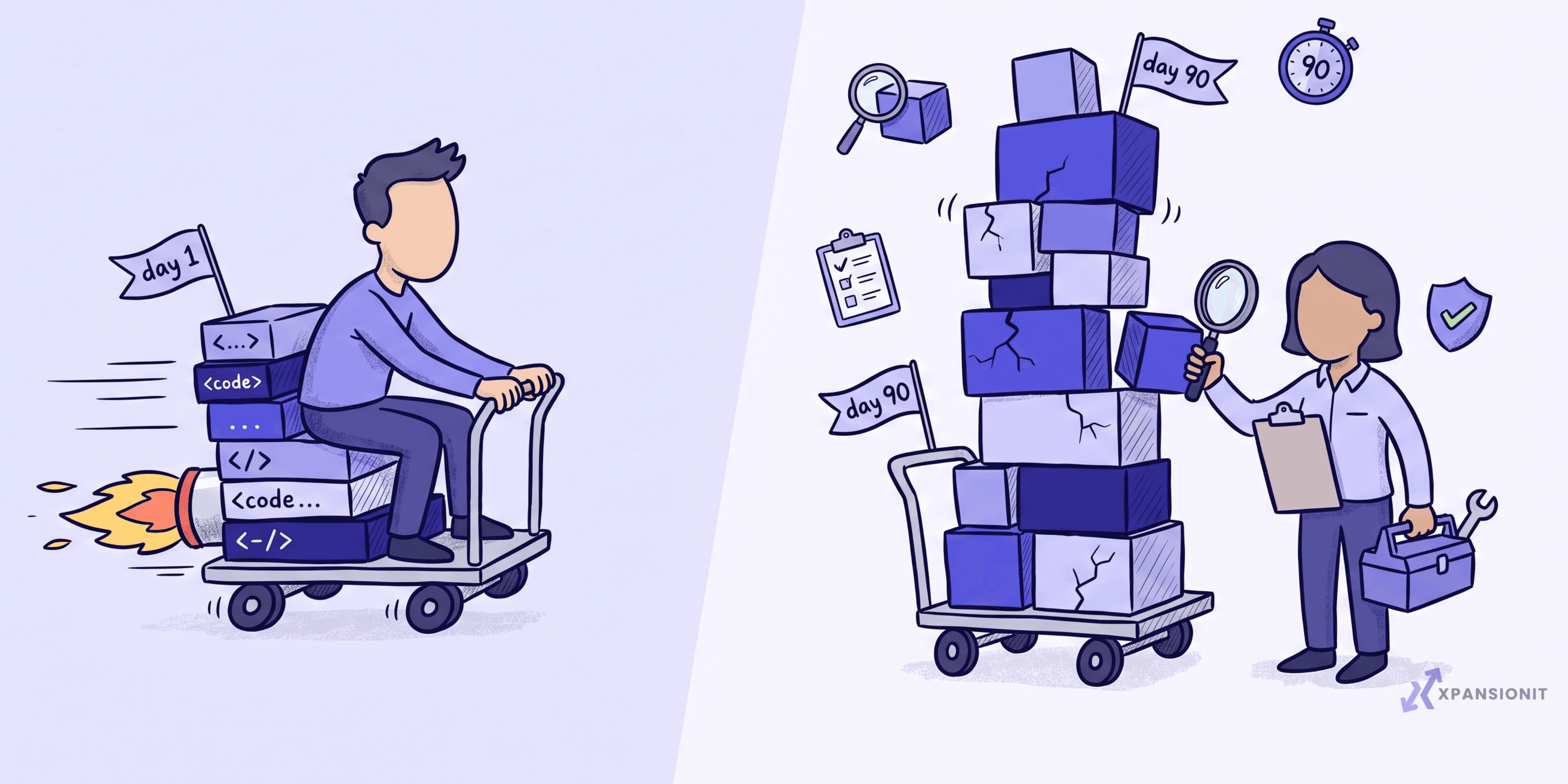
There is a rhythm to this that is consistent enough to plan around. For the first few weeks everything is wonderful, features ship faster than they ever have, and the team feels unstoppable. Then, roughly ninety days in, the slowdown starts. Bugs take longer to fix than they should. Nobody can explain why a particular function behaves the way it does. Teams at this point typically lose 20 to 30% of their sprint capacity to defects traceable to AI-generated code, which quietly cancels out the speed that made the approach attractive in the first place.
The reason it sneaks up on you is that the code looks fine. It compiles, it passes linting, it reads cleanly. What is missing is the thinking: why this structure, why this trade-off, what happens when the data grows. One study of millions of pull requests found technical debt rising 30 to 41% after teams adopted AI coding tools, with code duplication up 48% and refactoring activity down 60%. More code, less cleaning up after it.
The Security Problem Is the Serious One
Technical debt is expensive. Security debt is dangerous, and this is where the evidence is hardest to argue with. Testing across a wide range of models found around 45% of AI-generated code samples failed standard security tests. A scan of more than 1,400 vibe-coded production applications found 65% had security issues, with 58% containing at least one critical vulnerability. Comparative analysis of pull requests found AI co-authored code carried substantially more major issues than equivalent human-written code, with security problems appearing at several times the rate.
The pattern holds because AI writes code that satisfies the request, not code that anticipates an attacker. It does what you asked. It does not ask what happens when someone sends something you did not expect. For an app handling customer records, payments, or anything covered by Australian privacy obligations, that gap is not a technical footnote, it is your exposure. Our note on responsible AI in Australia covers the broader duty of care here.
What It Costs to Fix
This is where it stops being abstract. Of roughly ten thousand startups that shipped AI-built production apps by the end of 2025, more than eight thousand needed either a partial rebuild or rescue engineering by mid-2026. That is not a fringe outcome, that is the base case for ungoverned adoption.
The rescue bill scales with how long you left it. Configuration and architecture problems caught early on a small app with a clean data model are a contained job. An app that has been in production for eighteen months, iterated dozens of times, with a data model that cannot be migrated cleanly and security issues that need incident response as part of the work, is an order of magnitude worse. Maintenance costs on AI-generated code have been observed to climb dramatically inside the first eighteen months. The lesson is not that rescue is impossible, it is that the cost curve is steep, so the time to look is now rather than later. If your project is already at that point, this is exactly what our SaaS rescue and modernisation work exists for.
Where Vibe Coding Earns Its Place
Now the balance, because a blanket warning would be dishonest and we would not follow it ourselves. Vibe coding is excellent for prototypes, internal tools, throwaway scripts, and proving an idea before you commit real money to it. If the thing you are building will be looked at by five colleagues and deleted in a month, elaborate architecture is waste, and moving fast is correct.
It is also a fine accelerator inside a disciplined team. The distinction that matters is not whether AI wrote the code, it is whether a human who understands the system read it, questioned it, and owns it. That is why the same tools produce a clean asset in one team and a rescue job in another. If you are testing a business idea rather than building the real thing yet, our guide on how to build a micro SaaS covers the validate-first approach that makes this sensible, and taking software from prototype to production covers what has to change when it gets serious.
How to Get the Speed Without the Wreckage
A handful of habits separate the teams that benefit from the ones that end up calling someone like us.
Decide the architecture before you prompt. The structural decisions you make up front determine whether generated code becomes an asset or debt, and no amount of prompting fixes a bad foundation.
Make review non-negotiable, especially in the first thirty days. Someone who understands the system reads every line that ships. If nobody on the team can explain what a piece of code does, it is not ready for production, regardless of whether it works.
Insist on tests. Test coverage on vibe-coded projects tends to collapse, and tests are the thing that lets you change the code later with any confidence.
Run a security review before anything customer-facing goes live, and treat that as a fixed cost of shipping rather than an optional extra. Formal application security testing is the version of this we would run.
Then schedule the debt audit at ninety days instead of waiting for it to find you. The reckoning arrives either way. The only question is whether it is a planned maintenance window or an emergency.
When to Call Someone In
Be honest about the signals. If your app handles payments, health data, or personal information and nobody has formally reviewed what the AI produced, that review is overdue. If the original builder has moved on and no one left can explain the system, you have a knowledge problem as well as a code problem. If small changes routinely break unrelated things, the architecture is telling you something. And if you are about to raise money or sell, someone will look at this code properly, so it is better that it is you first.
None of that means a rebuild. Often the right answer is a targeted audit, a security pass, and refactoring the two or three areas carrying the real risk, which is a far smaller job than starting again.
Why This Matters to Us
We are a small Adelaide team, and we use these tools daily, so we are not standing outside this trend pointing at it. We are also the people who get called when a fast build stops being fast, and we have seen the same conversation enough times to recognise it: someone shipped something impressive quickly, the business grew around it, and now nobody can safely change it. The tools are not the problem. Shipping code that nobody understands is the problem, and that predates AI by decades. AI just made it much easier to do at speed.
What Do the Numbers Say?
Adoption has raced ahead of trust, and the quality data explains why.
| What the data shows | Figure |
|---|---|
| Developers who have adopted AI coding tools | around 84% |
| Developers who say they trust the output | 29% |
| AI-generated code failing standard security tests | about 45% |
| Vibe-coded production apps found to have security issues | 65% |
A Quick Word From Our Own Playbook
"AI does not write bad code. It writes code nobody read. Those turn out to be the same thing about ninety days later."
Want to know more? Read our take on the web development trends shaping 2026.
Talk to Us
If you have an app that was built fast with AI and you are not sure what is under the bonnet, we are happy to take a look and tell you where the real risk sits. Call us on +61 420 883 221 or tell us about your project, and we will give you a straight read on whether it needs an audit, a patch, or a proper rebuild, including telling you when it is fine as it is.
Whether that means a security pass, a targeted refactor, or rebuilding the parts that carry the risk, we work in phases so your product keeps running. Take a look at everything we do at XpansionIT, get to know who we are, or browse our services. If a fast build has stopped being fast, start with our SaaS rescue and modernisation work, our application security testing service, or our custom software and SaaS service, and when you are ready, get in touch.