Which Software Development Option Is Right in Australia?
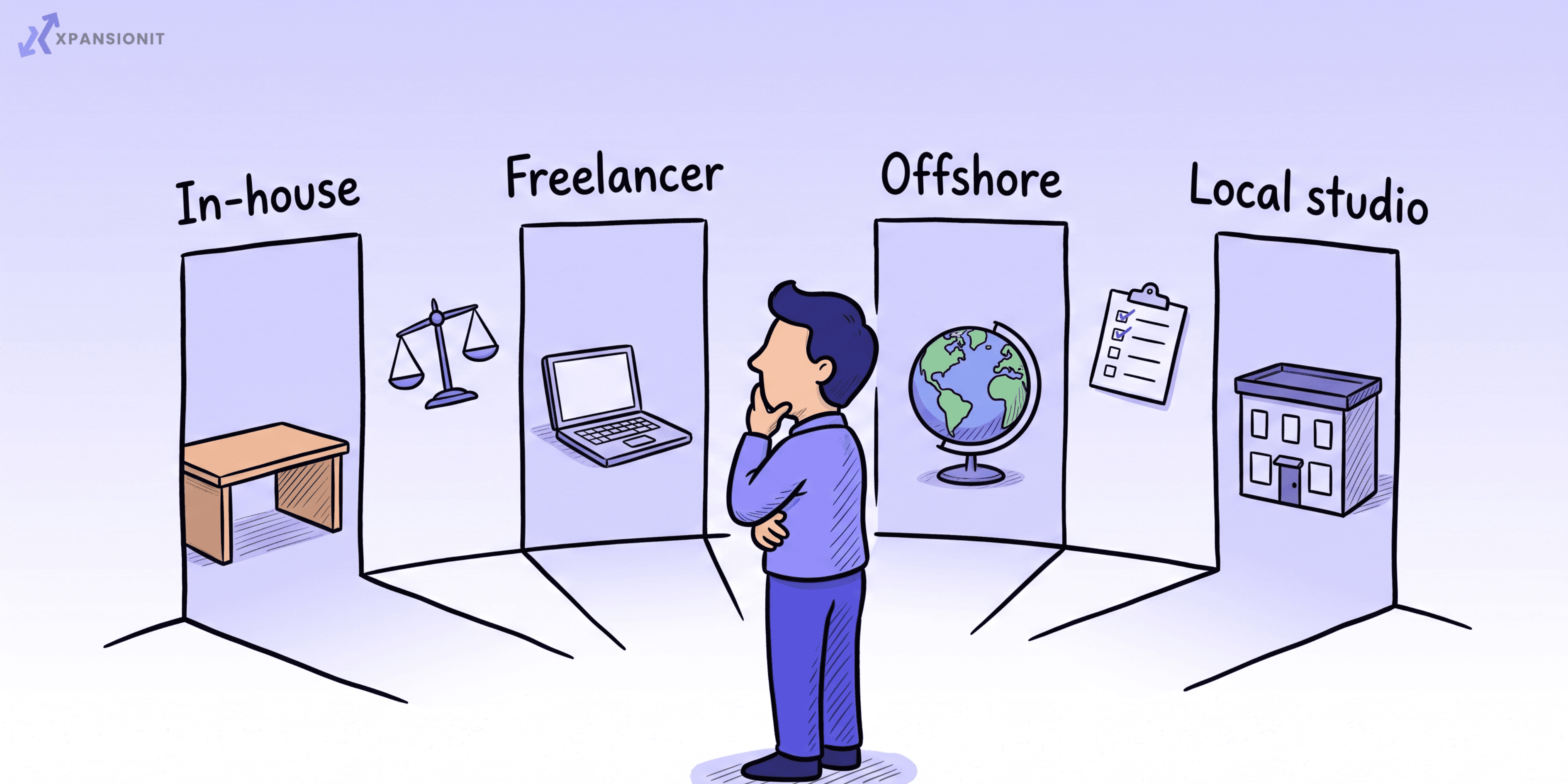
There are four common ways for an Australian business to get software built: hire in-house, use a freelancer, engage an offshore agency, or work with a local studio. None of them is best in general. The right choice depends on what you are building, how long you will be building it, how settled the requirements are, and how much of the work you can realistically manage yourself.
This is a comparison, not a sales pitch. Below are the four routes described plainly, a side-by-side table, the costs that do not appear in any table, a decision guide, and the few checks that matter whichever way you go.
The four routes, in brief
Hiring in-house means building your own team of developers as employees. You get the most control and the tightest day-to-day collaboration, and the knowledge stays inside your business. The trade-offs are cost and time. Recruiting strong developers in Australia takes months, salaries are ongoing whether or not there is work to fill them, and a small team carries key-person risk if someone leaves mid-project. In-house earns its keep when software is central to what you sell, not a one-off build.
Using a freelancer means contracting an individual for a defined piece of work. It is fast to start and cheap to trial, and for a small, clear scope it is often the most sensible option on this list. The risk is that you quietly become the manager, the quality checker, and the integrator. Quality varies enormously between individuals, one person can only cover so many skills, and if they move on, continuity becomes your problem. Freelancers do their best work on well-bounded tasks and struggle on mission-critical, long-running builds.
Engaging an offshore agency means outsourcing to a team in a lower-cost region. The appeal is the rate: the headline price per hour is often a fraction of local rates, and for cost-sensitive builds with strong internal management that can work well. The costs that erode the saving are coordination and communication. A large timezone gap slows every question and answer to a daily rhythm, requirements that are not crystal clear get interpreted rather than queried, and cross-border contracts make intellectual property harder to enforce if something goes wrong.
Working with a local studio means hiring an Australian team that builds software for a living. You get a ready-made team without the recruiting, an accountable company rather than a single person, references you can actually check, and collaboration in your own timezone and language. Maintenance after launch is usually on offer. It is not the cheapest route on a per-hour basis, and a studio that only ever agrees with you is selling rather than advising, so the value depends on choosing one that will tell you when not to build.
The options, side by side
| In-house hire | Freelancer | Offshore agency | Local studio | |
|---|---|---|---|---|
| Upfront cost | High | Low to moderate | Low to moderate | Moderate to high |
| Ongoing cost | High (salaries) | Pay as you go | Lower rates | Project or retainer |
| Time to start | Slow (hiring takes months) | Fast | Moderate | Fast |
| Control and risk | Full control, key-person risk | Variable, you manage it | Variable, more to coordinate | Accountable team, local references |
| Communication | Same room, same timezone | Often async | Large timezone gap | Same timezone and language |
| Code and IP | Fully yours | Yours with the right contract | Yours, but harder to enforce across borders | Yours, local jurisdiction |
| Maintenance after launch | Built in | Rarely | Sometimes | Usually offered |
The cost that does not show up on the table
The cheapest hourly rate is rarely the cheapest project, and this is where the table above can mislead. Three costs sit underneath every option and almost never appear in a quote.
The first is management. Someone in your business has to brief, review, test, and coordinate the work. A freelancer or an offshore team usually needs more of this than a studio or an in-house lead, and your time has a value even when no one invoices it.
The second is rework. Software built from a fuzzy brief, or with slow feedback loops, gets built wrong and then built again. A low rate paired with weak communication can cost more in total than a higher rate that ships the right thing once.
The third is the tail. Software is not a purchase, it is a commitment: it has to be hosted, patched, fixed, and grown for as long as you use it. An option with no maintenance path simply defers that problem to a later you, often at a worse price. We walk through the full picture in what custom software actually costs in Australia, and the ongoing cost is the line most people forget.
How to choose
| Option | Best when | Think twice if |
|---|---|---|
| In-house hire | Software is your core product, with a multi-year roadmap, and you can recruit and retain a team | It is a one-off build, or you cannot keep a team busy year-round |
| Freelancer | The scope is small and well defined, and you can manage and integrate the work | It is mission-critical, long-term, or needs more than one skill set |
| Offshore agency | Cost is the priority and you have the internal capacity to manage across timezones | Requirements are still fuzzy, or you need tight, real-time collaboration |
| Local studio | You want an accountable team and easy communication without hiring, plus local context like privacy and compliance | Rock-bottom price is your only deciding factor |
Read the decision table as a starting point, not a verdict. In practice the choice tends to come down to three questions. How clear are your requirements? Fuzzy requirements punish any option with slow communication, which pushes you toward in-house or a local studio where you can iterate quickly. How long will this run? A one-off build rarely justifies hiring, while a product you will grow for years rarely suits a lone freelancer. And how much can you manage? Every option except a full-service team assumes you will carry some of the coordination yourself, so be honest about the time you actually have.
Most businesses end up mixing these rather than picking one forever. A common and sensible pattern is to bring a studio or a freelancer in to build the first version, prove the product works, then hire in-house to maintain and extend it once the roadmap is clear and there is enough steady work to keep a team busy. Another is to keep a small in-house team for core work and use a studio for surge capacity or specialist skills you do not have on staff. There is no rule that you must choose one lane and stay in it.
What to check, whichever you choose
The route matters less than the diligence. Whoever builds your software, ask the same four things before you commit.
Ownership: confirm in writing that you own the code and the intellectual property once the work is paid for. This is easy to assume and expensive to get wrong, particularly with freelancers and across borders.
References: ask to speak to a past client, and ask that client what went wrong and how it was handled, not only what went well. How a builder deals with problems tells you more than a polished portfolio ever will.
Scoping: a good partner scopes the problem before quoting a price, and is willing to propose a smaller first step rather than the largest possible project.
Maintenance: agree up front who keeps the software running after launch, and at what cost. The cheapest build with no maintenance plan is often the most expensive choice across two years.
These are the same questions we set out in how to choose a development company in Australia, and they apply just as much to an in-house hire or a freelancer as to an agency.
A few things specific to Australia
Two local factors are worth weighing. Timezone is the obvious one: a team in your own or a nearby timezone can answer a question the same day, which matters far more on a fuzzy, fast-moving build than on a fixed, well-specified one. The less obvious factor is regulation. Australian businesses carry obligations under the Privacy Act and, increasingly, around how automated systems make decisions about people, and a builder who already works within Australian rules and jurisdiction is easier to hold accountable than one operating under a different legal system entirely. For software that handles personal information, that local context belongs in the cost-benefit, not in a footnote.
For the record, we are the fourth option: an Australian custom software development studio. We are not always the cheapest choice, and we will tell you if hiring internally, using a freelancer or choosing another route makes more sense for your project.
Talk to Us
If you are deciding whether to hire, outsource or work with a local development team, tell us what you are trying to build. We will help you understand which option fits the project, even if that option is not us.
Tell us about your project. If a dedicated development team is the right fit, you can also learn how we approach custom software development.