"What will it cost?" is the first question every Australian business asks about custom software, and the honest answer is "it depends." But that is not very useful when you are trying to budget. So this guide gives you the real numbers: typical hourly rates, project price ranges by size, what actually drives the custom software cost, and how to avoid overspending.
Hourly rates in Australia
Most Australian developers and agencies charge somewhere between AUD 80 and AUD 150 an hour. Junior developers sit at the lower end, mid-level engineers in the middle, and senior specialists or large enterprise consultancies well above it. Offshore developers can be much cheaper, often AUD 30 to AUD 60 an hour, but that headline rate hides real trade-offs we will get to.
The key point: the hourly rate is not the cost. The cost is the rate multiplied by the hours, and a cheaper rate often means more hours and more rework.
What custom software actually costs, by size
Project totals vary widely, so think in tiers rather than a single number. As a rough guide for software built in Australia:
- A simple, single-purpose tool or basic app: roughly AUD 20,000 to AUD 50,000. A boutique team can sometimes deliver a focused tool for less.
- A mid-sized custom application or platform: roughly AUD 50,000 to AUD 150,000. This is where most small and mid-sized business projects land.
- A complex, enterprise, or AI-powered platform: AUD 250,000 and up, sometimes far higher with a large consultancy.
One thing the ranges hide: the same functional outcome can cost very differently depending on who builds it. A large agency with project managers, designers, and QA layers carries overhead you pay for whether you need it or not. A focused team often delivers the same result for less because you are paying for the work, not the structure.
What drives the cost
The price is really a function of hours, and these are what add hours:
- Scope and complexity. More features and more screens mean more hours. This is the single biggest lever.
- Specific features. Logins and user roles, payments, third-party integrations, real-time updates, and AI components each add cost.
- Design. Thoughtful UI and UX design adds to the budget but usually pays for itself in adoption.
- Integrations. Connecting to the other systems you already run takes real effort.
- Compliance and security. Privacy and security requirements are not optional and add to the build.
- Maintenance. Budget for ongoing support and hosting, typically a percentage of the build cost each year.
The mistake that costs the most: choosing an hourly rate
The most expensive error is picking a provider based on hourly rate instead of total cost. A cheap offshore quote often produces code that needs heavy fixing, and the savings get eaten by rework, miscommunication, and the time your team spends managing it, frequently within the first year. Local development costs more per hour but usually takes fewer hours, produces less rework, and the people building it can understand your business directly. Cheaper per hour, dearer per project, is a very common outcome.
The right comparison: custom versus the status quo
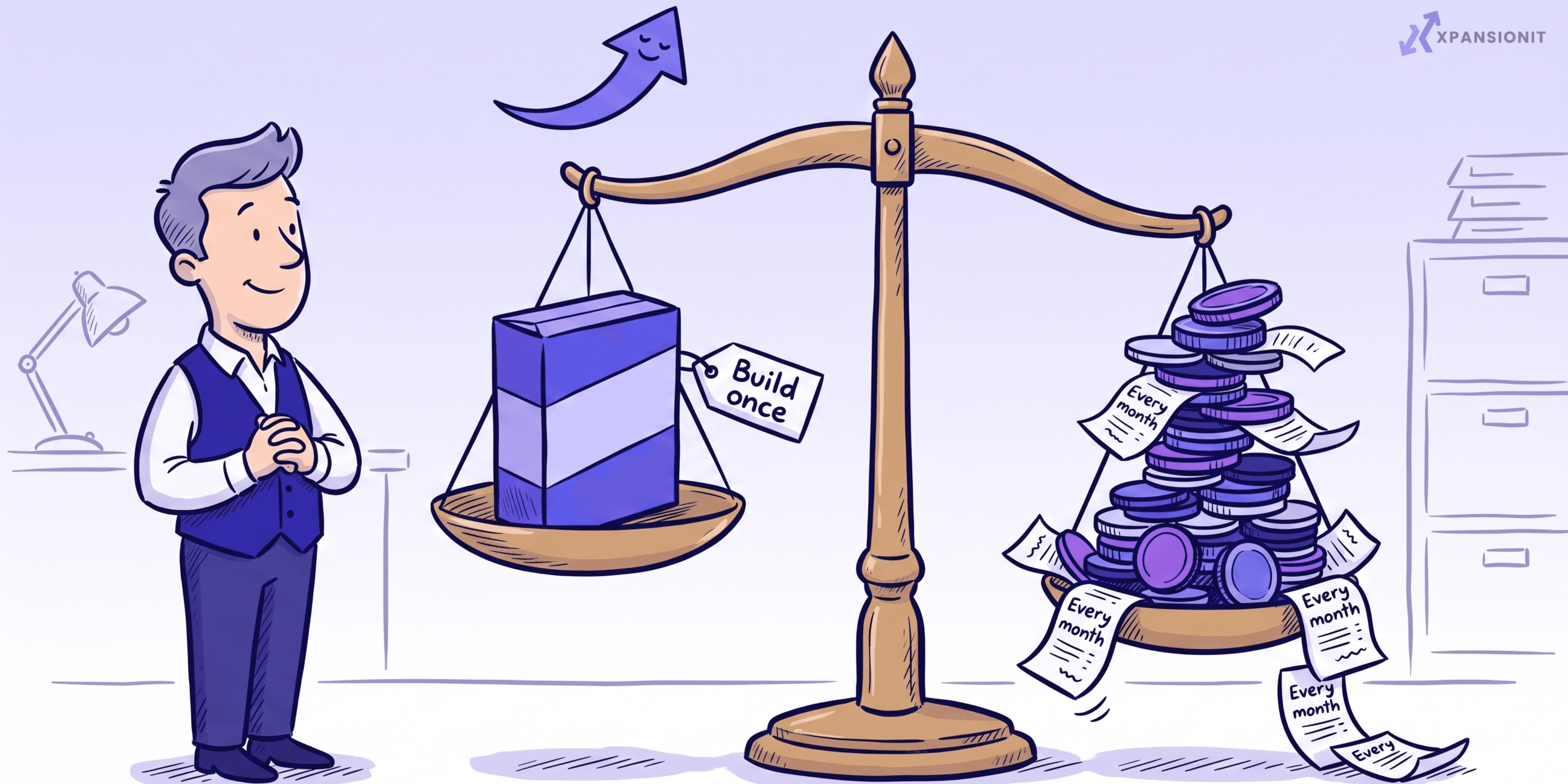
Businesses often compare a custom build against the monthly subscription price of an off-the-shelf tool. That is the wrong comparison. The right one is the cost of custom software against the total cost of your current situation over three years: subscription fees per seat, the manual work nobody counts, and the deals or hours lost to a tool that does not fit. For many businesses, those costs overtake the build cost of custom software within 18 to 36 months, after which custom software keeps saving. We unpack that decision in outgrowing WordPress and in our guide to SaaS development done right.
An Australian advantage worth knowing
If your project involves genuine technical development, you may be able to claw back a large share of the spend. The federal R&D Tax Incentive offers eligible companies a refundable tax offset of up to 43.5% on qualifying research and development. It does not apply to every project, but for genuinely novel software, it can change the maths significantly, so it is worth asking your accountant about early.
How to keep the cost sensible
You can control the budget without cutting corners:
- Start with an MVP. Build the few features that matter first, prove it works, then expand. This is the heart of our micro SaaS approach.
- Lock the scope in writing. Scope creep is the quiet budget killer.
- Prefer fixed-price over open-ended hourly. It puts the estimating risk on the builder, not you.
- Make sure you own the source code. You should be able to host and change it anywhere.
How to get an accurate number
The ranges above are for planning, not quoting. The only way to a real figure is a fixed-price quote scoped to your actual needs by a development partner who has understood your business. That is exactly how our custom software and SaaS development work begins, with scope before price.
The short version
Custom software in Australia typically costs AUD 80 to 150 an hour, with simple tools from around AUD 20,000, mid-sized platforms from AUD 50,000 to 150,000, and complex or AI systems well beyond that. The cost is driven by scope, features, integrations, and compliance, not the hourly rate alone. Judge it against the three-year cost of your status quo, not a monthly subscription; start with an MVP to control spend, and check whether the R&D Tax Incentive applies.
If you want a real, fixed-price number for your project, you can book an intro call and we will scope it properly before quoting.