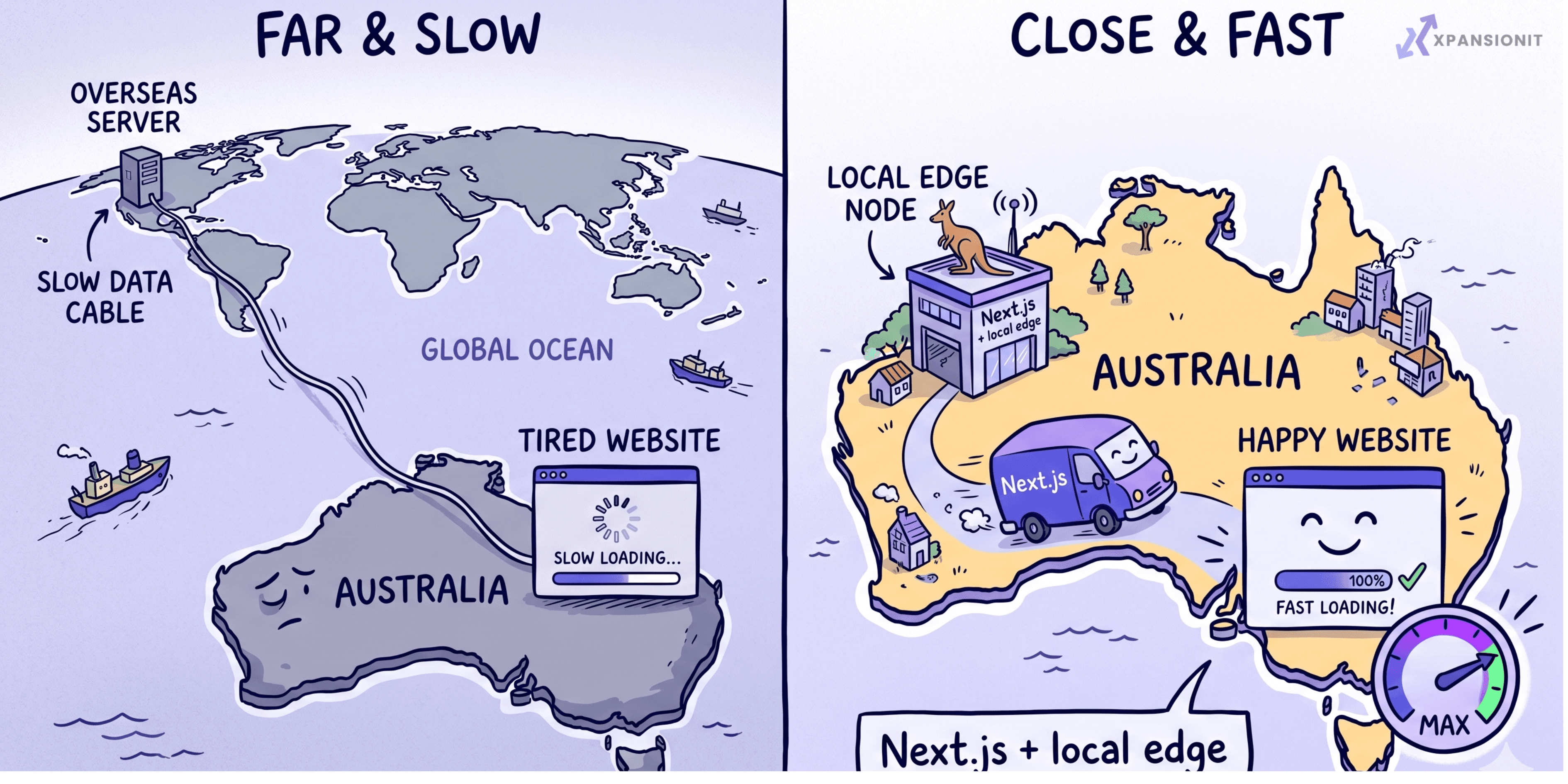
Australians spent a record $82.6 billion online in 2025, so the visitors and the money are there. The problem is how many of them leave before a slow page even finishes loading. And a lot of Australian websites are slow for a reason that has nothing to do with bad code. It is geography. Most of the world's web infrastructure sits in the United States and Europe, and Australia is a very long way from it.
This guide explains why Australian websites tend to load slowly, why that quietly costs you sales and rankings, and the specific fixes that make them fast.
Why Australian websites are slow
There are usually four reasons stacked on top of each other.
Distance to the server. If your site is hosted in the United States, every single request from an Australian visitor has to cross the Pacific and come back. That round trip adds real delay on top of everything else, often well over 100 milliseconds before your server has done any work. Multiply that across all the files a page needs and it adds up fast.
No content delivery network. A CDN keeps copies of your images, scripts, and styles on servers close to the visitor. Without one, an Australian shopper is pulling every asset from the other side of the planet.
Heavy builds. Off the shelf themes carry code you never use, and every app, tracking pixel, and chat widget piles on more weight. A bloated page is slow everywhere, but it punishes far away visitors hardest.
Our connections are good, not great. Australia sits around the high 40s globally for fixed broadband speed on Ookla's Speedtest Global Index, and regional and rural connections are slower again. A heavy, far away site is a worse experience for an Australian audience than it would be for users sitting next to the server in California.
Why slow pages cost you
This is not a vanity metric. Speed maps straight to money and to rankings.
- Google and Deloitte found that even a 0.1 second improvement in mobile speed lifted retail conversions by around 8%.
- Research by Portent found that pages loading in one second convert about three times higher than pages taking five.
- Google uses page experience and Core Web Vitals as a ranking signal, so a slow site is harder to find in the first place.
For an Australian business competing for local searches, a fast site is both more visible and more likely to convert the visitors it gets.
How to fix slow Australian websites
The good news is that the distance problem is very fixable. Here is the order that gives the biggest gains.
- Host in or near Australia. Move your site onto infrastructure with an Australian presence. The major cloud providers run local regions, including AWS in Sydney and Melbourne, so your server can sit close to your audience instead of across an ocean.
- Put a CDN in front of it. A CDN with Australian edge locations serves your images, fonts, and scripts from inside the country, so they arrive almost instantly no matter where your main server lives.
- Build lean. Use a modern framework like Next.js, pre-render pages so they load fast, compress and correctly size images, and cut the scripts and widgets you do not need. This is core full stack web development work, not an afterthought.
- Design for real Australian connections. Build mobile first and test on a regional-grade connection, not just office fibre. Good UI and UX design keeps the experience smooth when the connection is not perfect.
- Measure it. Check your real pages with Google PageSpeed Insights and watch your Core Web Vitals. Fix the worst offenders first.
Keeping a site fast over time is its own job, which is where ongoing web application maintenance earns its place, because speed quietly erodes as content and plugins build up.
The local SEO bonus
Speed pays a second dividend in Australia. A site that loads fast, is hosted locally, and is clearly relevant to an Australian audience sends strong local signals to Google. Combined with accurate business details and genuinely useful content, that helps you rank for the local searches that bring in customers, rather than getting lost behind slower overseas competitors.
How to start
Do not guess. Run your most important pages through PageSpeed Insights from an Australian connection, and find out where your site is actually hosted. If it sits overseas with no CDN, that is your single biggest, easiest win. Move it closer, put a CDN in front, then trim the page weight.
The short version
Many Australian websites are slow because they are hosted far away, served without a CDN, and built too heavy, on connections that are good but not the world's fastest. Speed drives both conversions and rankings, so the fix is direct: host in or near Australia, add a CDN, build lean, and measure Core Web Vitals.
If you want to know why your site is slow and what it would take to fix, you can book an intro call and we will check your speed and hosting before any work begins.