If you have looked into building a SaaS lately, you have heard one answer over and over: use Next.js. It has become the default, used by around 59% of developers and the dominant React-based full-stack framework, powering products from Netflix to TikTok and a huge share of the SaaS apps launched each year. But "default" is not the same as "right for you."
This guide covers why Next.js works so well for a SaaS, the trade-offs nobody puts in the sales pitch, and when it is the wrong call.
What Next.js actually is
In plain terms, Next.js is a framework built on React that handles rendering, routing, and a good chunk of the backend (API routes and server actions) in a single codebase. You build the front end and much of the back end in the same project, rather than wiring two separate apps together. It also pioneered production-ready React Server Components, developed in close collaboration with the React team, and remains the only framework with full production-ready support for them.
Why Next.js suits a SaaS
There is a real case behind the hype.
- It is fast by default. Server-first rendering sends the browser finished HTML, so pages load quickly. That matters, because a 0.1 second speed improvement lifted retail conversions by around 8% in Google and Deloitte's research, and the same speed habits we cover in building faster websites apply directly to a SaaS.
- It is SEO-friendly. Unlike a pure client-side single-page app, server-rendered pages get indexed properly, which is exactly what your SaaS marketing and landing pages need to be found.
- It is full-stack in one place. Front end plus API routes and server actions means fewer moving parts and faster building, which is ideal for a lean team or an MVP.
- It scales from MVP to production. Static, server, and edge rendering per route let the same codebase grow with you, the kind of path we describe in taking a SaaS from prototype to production.
- It has the deepest talent pool and tooling. Easy to hire for, a massive ecosystem, and strong support from AI coding tools, so you ship faster. Server-first rendering being the default is one of the bigger shifts we flagged in the 2026 web development trends.
Where Next.js is not the right choice
This is the part most "just use Next.js" advice skips.
- A simple brochure site. Next.js is overkill. A lighter static setup will do, and cost less to run.
- A heavy or specialised backend. API routes and server actions are great for app logic, but a data-intensive, real-time, or streaming backend often wants a dedicated service alongside Next.js rather than everything crammed into it.
- A mobile-first product. Next.js is for the web. A native or cross-platform app needs its own approach, with Next.js powering the web side only.
- A team without React skills. There is a real learning curve. The App Router and Server Components are powerful but genuinely complex, and that complexity has drawn criticism: in the latest State of JavaScript survey, Next.js generated the most comments of any project, with notably mixed sentiment. Be honest about your team before committing.
- An unusual architecture. If you would spend your time fighting the framework's conventions, pick a tool that fits the shape of your problem.
How Next.js fits a real SaaS build
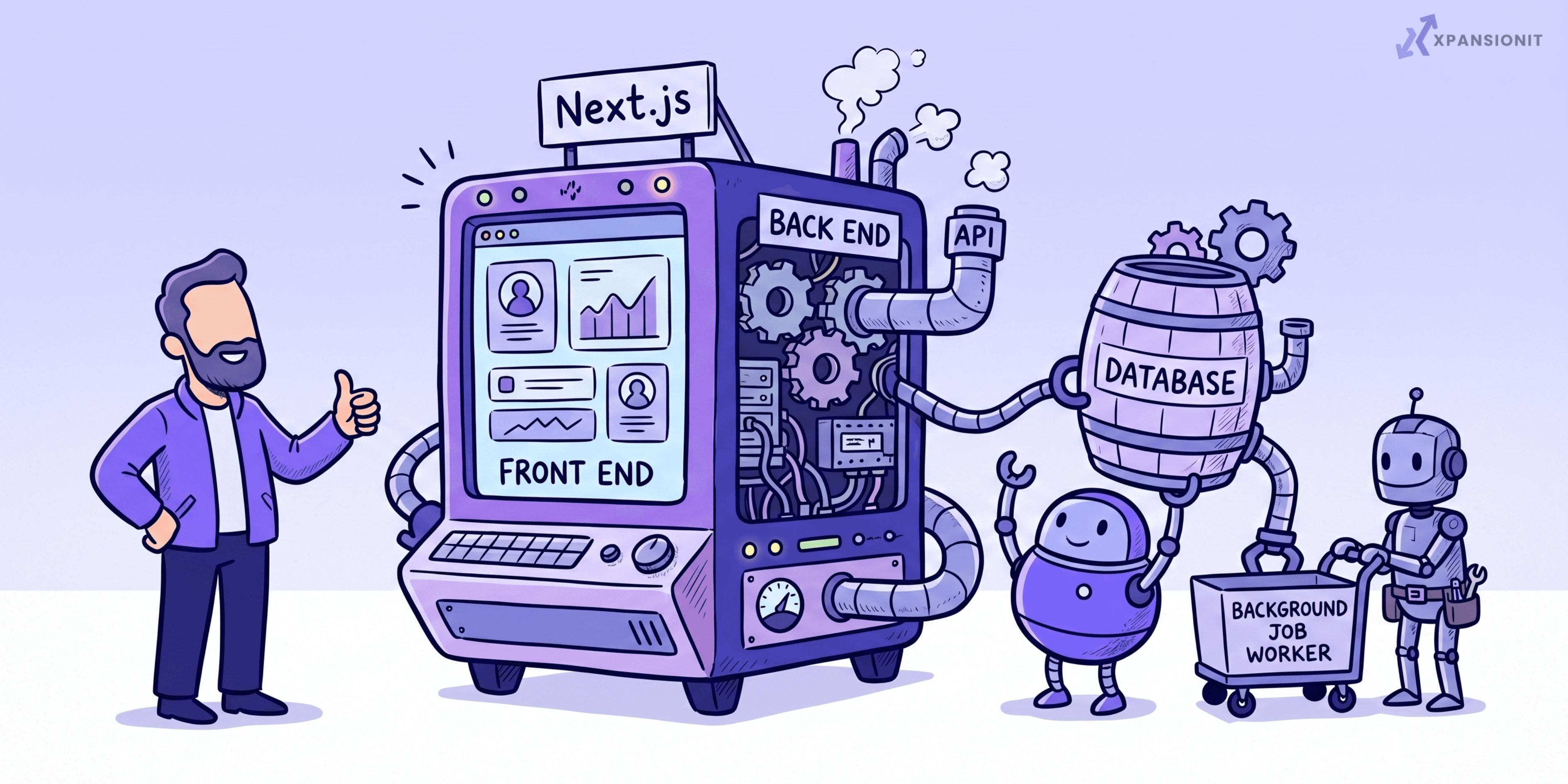
A typical production stack is Next.js for the app and marketing site, a proper database, authentication, billing, and usually a separate worker or queue for background jobs. That is standard full stack web development on a sound SaaS platform foundation. For an AI product, Next.js pairs cleanly with AI APIs, which we get into in how to build an AI SaaS. And if you are moving off a page builder, Next.js is the usual destination, as covered in outgrowing WordPress.
Common mistakes
- Treating Next.js API routes as a full, heavy backend for everything.
- Ignoring your rendering and caching strategy, then wondering where the speed went.
- Shipping too much client-side JavaScript, which quietly undoes the performance you chose Next.js for.
- Skipping the unglamorous production work (auth, billing, background jobs) because the front end came together quickly.
How to decide
If you are building a web-first SaaS that needs speed, search visibility, and fast iteration, Next.js is a strong, safe default with the deepest hiring pool and ecosystem available. If your product is real-time-heavy, backend-intensive, or mobile-first, choose deliberately rather than by reflex. The right answer is the stack that fits your product, not the one that is trending.
The short version
Next.js has become the default for SaaS because it is fast by default, SEO-friendly, full-stack in one codebase, scalable from MVP to production, and easy to hire for. It is the wrong choice for simple brochure sites, heavy specialised backends, mobile-first products, and teams without React experience, and its complexity is a real trade-off. Use it for a web-first SaaS that needs speed and iteration, and pair it with the right database, auth, billing, and background jobs.
If you are choosing a stack for your SaaS and want a straight opinion on whether Next.js fits, you can book an intro call and we will tell you before any work begins.