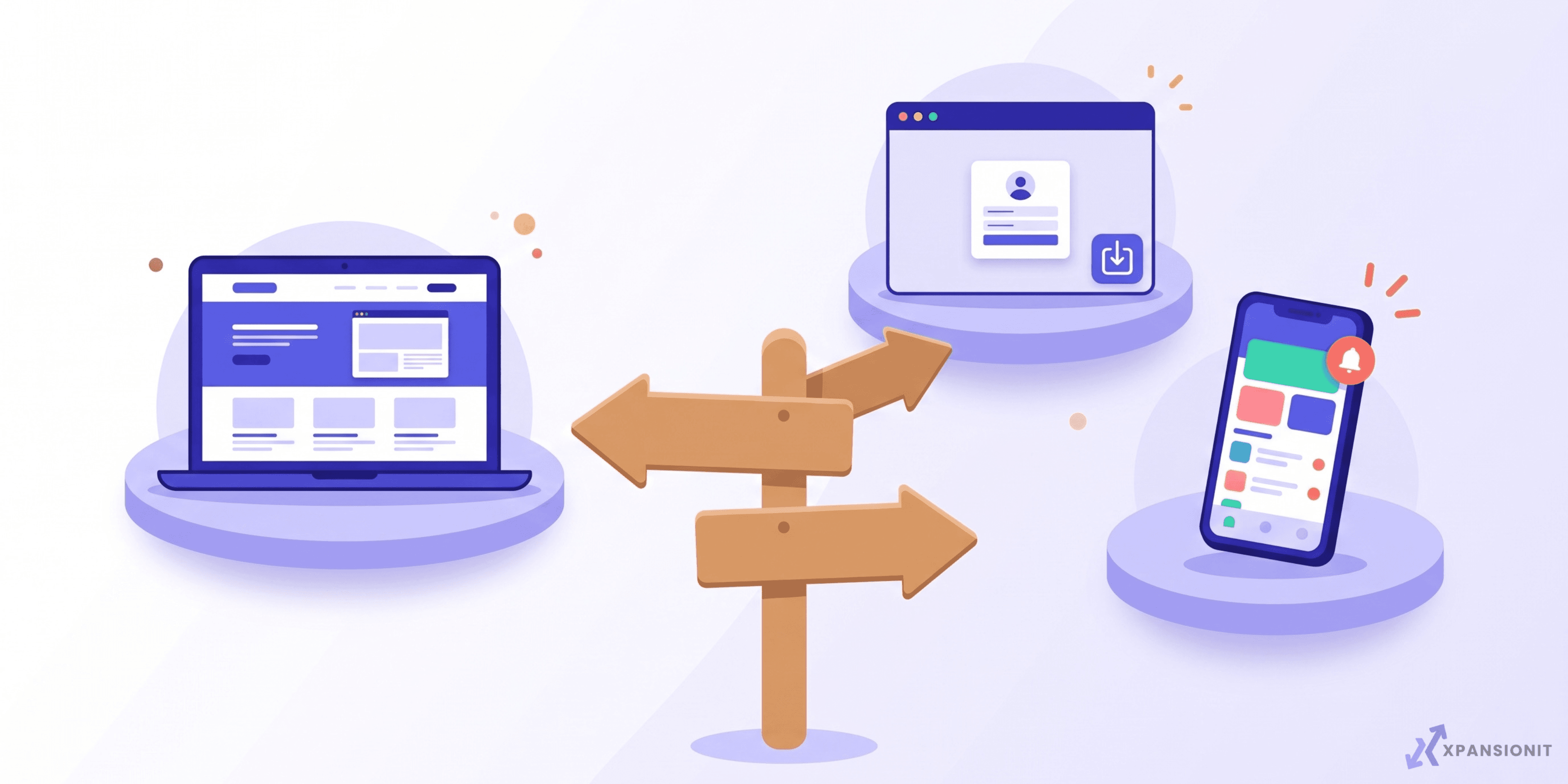
Do You Need a Website or an App?
For most businesses, the answer is a website first. An app only makes sense when your customers use you often, need something a phone does better than a browser, or when the app itself is the product you sell.
That's the short version. The rest of this post helps you work out which camp you're in, because getting it wrong can cost you a lot of money for something nobody uses.
The Question We Hear Most
It usually comes up like this. A business is growing, a competitor has just launched an app, and someone in the team says, "We should have one too."
Sometimes they're right. More often, what they need is a better website, or a website that does a bit more. An app sounds more impressive, but impressive and useful aren't the same thing.
What a Website Does Well
A website is how people find you. Someone searches on Google, clicks, and they're there. No download, no account, no waiting.
It works on every phone, tablet and computer. You update it once and everyone sees the change straight away. And it's usually the cheaper of the two to build and look after.
If your customers mostly visit to learn about you, get in touch, book something or buy something now and then, a good website covers it.
What an App Does Well
An app earns its place when people use you again and again. Think of how often you open your banking app, a food delivery app or a gym booking app. That habit is what makes an app worth building.
Apps are also better when you need things the phone does well:
- Notifications that remind people to come back.
- The camera, for scanning or taking photos.
- Location, for tracking or finding the nearest store.
- Working offline, when there's no signal.
The catch is that people have to find it, download it and keep it on their phone. That's a big ask if they only need you twice a year.
The Option in the Middle
There's a third option many businesses don't know about: a web app. It runs in the browser like a website, but it behaves like an app. People can log in, save things, get updates and even add it to their home screen, without going through an app store.
For a lot of businesses, this is the sweet spot. You get most of what an app offers, one version works on every device, and you skip the app store approval process entirely.
Side by Side
| Website | Web app | Mobile app | |
|---|---|---|---|
| Best for | Being found and getting enquiries | Tools customers log into | Daily or weekly use |
| How people find it | Google search | Google search or a link | App Store and Google Play |
| Works on | Every device | Every device | The phones you build it for |
| Updates | Instantly | Instantly | Through app store releases |
| Ongoing upkeep | Low | Medium | Higher, with regular updates |
Five Questions to Help You Decide
Answer these and the choice usually becomes obvious.
- How often will customers use it? Daily or weekly points to an app. Now and then points to a website.
- Do you need the phone's features? If you need the camera, location or notifications, an app or web app makes sense.
- Will people download it? Ask a few real customers. If they shrug, that tells you a lot.
- How will new customers find you? If most come from Google, you need a strong website either way.
- Can you look after it? Apps need updates every time Apple or Google change something. Budget for that from day one.
Where It Goes Wrong
The most common mistake is building an app nobody downloads. It looks great in the launch post, then sits unused because customers didn't need it.
The second is building two apps. An iPhone app and an Android app can mean two builds and two sets of updates, unless you choose a cross-platform approach from the start. We explain the difference in our guide to native vs cross-platform app development.
The third is forgetting the website. Even if you build a brilliant app, people still search on Google first. If your website is weak, many of them never get as far as the app.
Our Advice
Start with what your customers need, not what your competitors have. For most businesses that's a fast, clear website. For businesses where customers log in and use a tool, it's a web app. And for businesses whose customers use them every day, it's an app.
If you're not sure what any of these would cost for your business, our breakdown of custom software costs in Australia is a good place to start.
Not Sure Which One You Need?
Tell us what your business does and how your customers use you, and we'll tell you straight whether you need a website, a web app or a mobile app. We quote a fixed price, so you'll know the full cost before anything starts.
See how we build websites and web applications, or send us a message.