An adaptive AI learning companion that makes the national curriculum accessible to SEND pupils
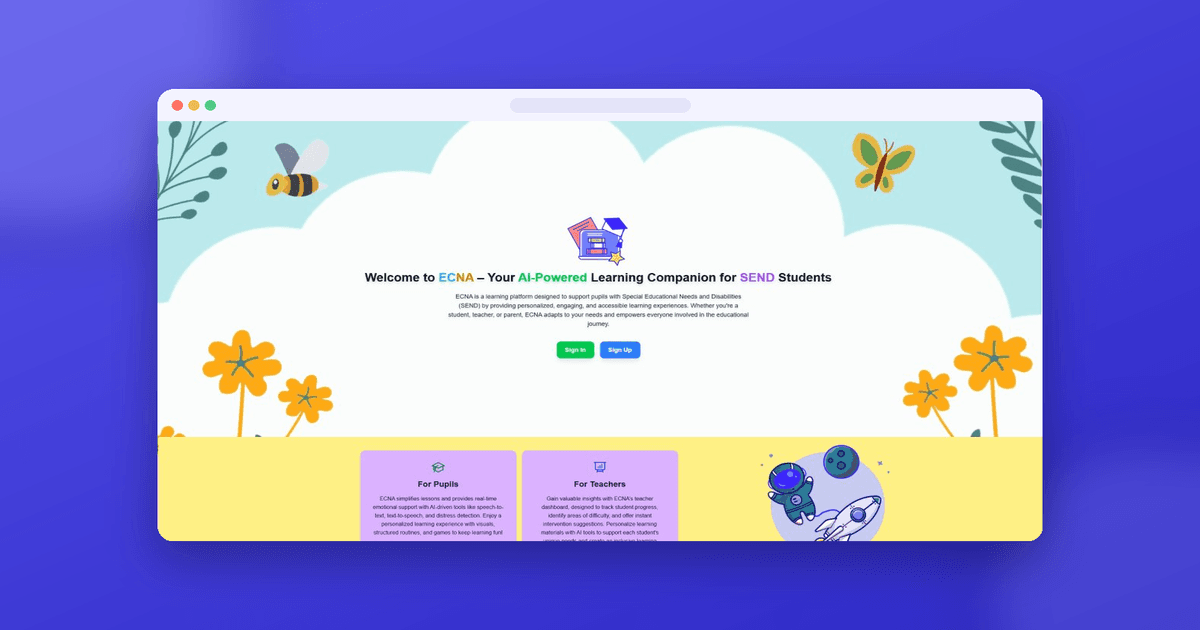
ECNA is an AI learning platform for pupils with Special Educational Needs and Disabilities. It delivers the UK national curriculum through an adaptive layer that tailors each lesson to the individual child, detects frustration in real time, and supports text, audio, and voice. Teachers get live visibility into progress and wellbeing, so they can step in before a pupil falls behind.
- Client
- ECNA
- Industry
- Education Technology (EdTech)
Outcomes
The numbers we shipped against.
100
Connected audiences
6
Task-tuned AI features
6
OpenAI models orchestrated
The story
How the engagement ran.
Problem
Mainstream digital learning tools are built for the average learner. For pupils with Special Educational Needs and Disabilities (SEND), that creates real barriers:
- Content pitched at the wrong cognitive level, or written in language that is hard to access
- No support for non-text communication such as speech, audio, or visuals
- No awareness of frustration, distress, or disengagement as it happens
- Teachers left guessing which pupils are struggling, and why
The brief was to deliver the national curriculum inclusively and provide individualised SEND support in one platform. The guiding principle was simple: SEND pupils do not need a different curriculum, they need the same one delivered in a way that adapts to how they learn, communicate, and manage emotion.
Approach
We built ECNA on Next.js 15 and React 19, with Firebase handling authentication and data and OpenAI models driving the adaptive layer. The platform serves three connected audiences, pupils, teachers, and parents, around one adaptive core.
Per-pupil profile that drives the AI Each pupil has a profile covering diagnosis, preferred learning styles, communication needs, engagement patterns, known signs of distress, and the support strategies that work for them. It also holds a learning age, separate from chronological age, mapped to the correct curriculum key stage. This profile is injected into the AI prompts, so tone, complexity, and explanations are tailored per pupil.
Eileen, an emotionally aware tutor The conversational tutor detects frustration from language cues and tracks a running frustration score saved to the database. It responds to inactivity in stages: a gentle check-in, then a hint, then a short game or break. Built-in games act as sanctioned regulation breaks that reset the frustration state.
Multimodal accessibility
- Text to speech on all content, tuned slower and warmer for children
- Voice input via the Web Speech API
- Real-time voice conversation using OpenAI's GPT-4o realtime model over a custom WebSocket proxy
- Audio on quizzes, image-based answers, and worksheets
AI content generation Lesson simplification into plain, structured language; a story mode; real-life application examples; text-free illustrations via DALL-E 3; and a worksheet helper that reads an uploaded PDF and tutors the pupil through it.
Curriculum integration Deep integration with the Oak National Academy open API delivers standards-aligned key stages, subjects, units, lessons, slide decks, videos, worksheets, and quizzes, proxied securely through the app.
Teacher dashboard A per-pupil view across three tabs: Profile (SEND data and current emotional status), Progress (completion and starter versus exit quiz scores), and Activity (a login calendar showing attendance gaps).
Key engineering decision OpenAI access was segmented across separate API keys per feature (chat, story, image, simplify, speech, voice). The trade-off was more configuration up front, in return for granular cost tracking, usage isolation, and per-feature rate control.
Outcome
ECNA brings adaptive content, real-time emotional awareness, multimodal accessibility, and teacher visibility into one platform, so the national curriculum becomes reachable for pupils who are usually underserved by tools built for the average learner.
- Pupils get lessons matched to how they learn, and a tutor that notices struggle and offers the right support before frustration takes over.
- Teachers get early, actionable insight instead of guesswork, and can adjust strategies for the pupils who need it most.
- Parents stay connected to the same view of progress and wellbeing.
The platform is a working demonstration of generative AI applied responsibly to genuine inclusion. It does not change what a pupil is taught, it changes how the same standard of learning is delivered, one pupil at a time.
Tech stack
What it was built with.
What stood out about ECNA is that it does not water the curriculum down for SEND pupils, it changes how it reaches them. Seeing a tool adapt to how a child learns and step in the moment they get stuck, while giving teachers a clear view of who needs support, is the kind of inclusion we want more of
Catherine Kane
Director of Special Education, UK Education Ministry