What AI Does for an Accounting Firm
How AI Helps Australian Accountants Right Now
You did not train as an accountant to key in receipts or match bank feeds line by line. AI for accountants is how you hand that work to software and get your judgement back where it belongs. We at XpansionIT build these systems for Australian firms, and the honest part is that the wins are quiet ones: the reconciliation that is 90% done before anyone opens it, the BAS worksheet drafted overnight, the client email answered before you reach your desk. We will walk through what AI does well in a practice, when an off the shelf tool is enough, when a custom build pays off, and how to stay square with the Tax Practitioners Board while you do it.
What Can AI Do for an Accountant?
It reads receipts and invoices, matches most bank transactions, drafts BAS worksheets, triages and answers routine client emails, flags unusual transactions, and builds cash flow forecasts. The accountant reviews, applies judgement, and signs off. In practice it removes a large share of the data entry that fills a bookkeeper's week.
Start With the Grunt Work
Here is where the return really lives. A junior bookkeeper can spend three to six hours per client reconciling Xero or MYOB against the bank feed, and most of that is matching transactions that were never in doubt. AI does the obvious 80 to 90% automatically, gives each match a confidence score, and flags only what needs a human eye. Receipt and invoice capture is the same story: modern tools read a PDF, a photo, even a screenshot, pull the vendor, ABN, GST and totals with accuracy above 99%, and push a coded entry into your accounting system with the source attached. If you are still choosing tools, our guide to choosing AI accounting software covers what to check before you commit.
The effect is not small. One Brisbane firm of six cut its data entry from 28 hours a week to under three, and redirected two bookkeepers to advisory work, lifting billable revenue per staff member by 38%. That is the pattern we see: the machine takes the repetitive volume, the people move up the value chain. If you want a sense of what is safe to hand over first, our guide on what to automate applies just as well to a practice as to any other business.
The Jobs AI Handles Well in a Practice
Strip away the noise and a handful of tasks deliver most of the value.
Bank reconciliation and coding. AI matches the predictable transactions, learns your chart of accounts, and hands the outliers to a person. A bookkeeper who once coded four hundred lines a day now reviews and intervenes on the few that need thought.
Invoice and receipt capture. Optical character recognition reads the document and files it correctly, which is where a lot of after-hours admin quietly disappears.
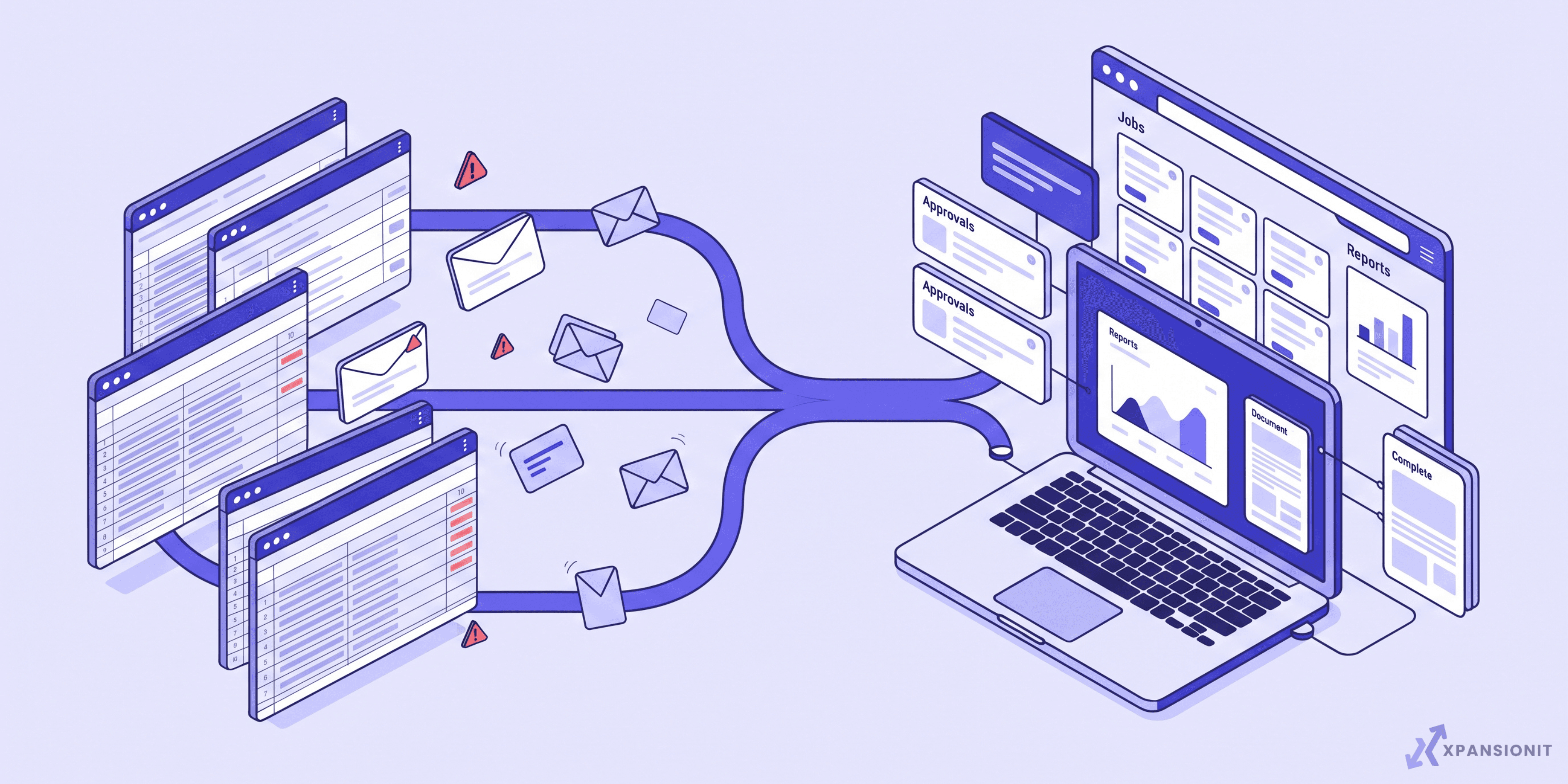
BAS and reporting drafts. Quarterly BAS prep for a portfolio of clients is mostly mechanical: pull the data, run the calculation, format the worksheet, draft the email. Paired with capture, this alone can recover twenty or more hours a week per bookkeeper.
Client email and queries. A large share of inbound email is routine, like when a BAS is due or a request for a profit and loss. An AI assistant can draft replies in your firm's voice and attach the right report, with anything sensitive routed to a human.
Anomaly detection and forecasting. AI flags unusual transactions across payroll and BAS records, and builds cash flow forecasts from historical data, moving accountants from writing reports to interpreting them. If the payroll system itself is the problem, see payroll platforms for large Australian businesses.
Off the Shelf or Custom: When to Build
Be honest about where you are before you spend. A solo practitioner or a small firm does not need a custom build. Xero's JAX, QuickBooks with Intuit AI, a receipt tool like Dext, and a general assistant for drafting will cover most of the wins, with core plans running from a few dollars to just over a hundred a month per seat. If that is you, a custom project is not worth it yet.
You start to outgrow the off the shelf stack when the tools cannot talk to each other, when you are copying data between five subscriptions and a spreadsheet, or when your firm's workflow is its own. That is the point where building AI into your own systems earns its keep. A focused automation, such as invoice extraction and BAS drafts wired straight into your Xero or MYOB, typically starts in the low thousands, and it often pays back inside a quarter rather than a year. This is proper AI integration for the Australian market, built on your data. If you want the version that acts on its own, qualifying and drafting without waiting to be asked, that is agentic AI, and it needs proper guardrails. For a sense of what a build like this costs, our note on custom software cost in Australia is a fair starting point.
The Compliance Part You Cannot Skip
Here is the bit the tool ads leave out. In Australia the Tax Practitioners Board holds the registered practitioner responsible for anything lodged with the ATO, no matter what software prepared it. The rule of thumb the profession has settled on is simple: AI prepares, the professional authorises. Regulators including ASIC and AUSTRAC are sharpening their focus on AI governance in financial services, and CA ANZ now runs ethics-in-AI training, so this is not a fringe concern.
In practice that means a few habits. Keep a human reviewing and signing off anything that goes to a client or the ATO. Add a line to your engagement letters noting that you may use AI tools with all output reviewed by a registered practitioner, which is standard in 2026. Never paste client names or financials into a public AI tool, and prefer platforms with Australian data residency. And from 10 December 2026, if your systems make automated decisions that significantly affect a person, your privacy policy has to disclose it. We treat all of this as part of the build, which is the whole point of doing AI responsibly in Australia.
Will AI Replace Accountants?
No, and the data backs it. AI cannot reassure an anxious client, weigh a grey area in the tax law, or carry the personal responsibility of signing off compliance. What it does is swallow the repetitive, rules-based work that fills the day before the EOFY rush. The honest version of the warning is not that AI will replace accountants. It is that accountants who use AI will out-compete the ones who do not.
Why This Matters to Us
We are a small Adelaide team, and we build for other Australian businesses, so this is not theoretical for us. We have seen practices hand-key thousands of supplier invoices a month and watch their monthly close drag out for a fortnight, when the same work rebuilt around the right tools closes in days. Handing that time back, so your people spend it on advice rather than admin, and doing it in a way that keeps a registered practitioner firmly in control, is the part of the work we care about.
What Do the Numbers Say?
Adoption is no longer the story, execution is. Around 92% of accounting professionals now use AI in some form, and among Australian mid-market practices roughly 71% of finance teams have it in play. Where it is applied to bookkeeping, it can cut manual work by up to 80%. And the return holds up: the large majority of accountants using AI report a positive return on investment, mostly through fewer errors and reclaimed hours. The gap now is between the firms that have wired it into their workflow and the ones still dabbling.
| What the data shows | Figure |
|---|---|
| Accounting professionals using AI (global) | 92% |
| Australian mid-market finance teams using AI | 71% |
| Manual bookkeeping work AI can remove | up to 80% |
| AI-using accountants reporting positive ROI | 89% |
A Quick Word From Our Own Playbook
"The firm that pulls ahead is not the one with the most AI tools. It is the one that automated the grunt work so its people had time to advise."
Want to know more? Read how AI agents work for Australian business.
Talk to Us
If you want a straight answer about what is worth automating in your practice, and what would just be another subscription, we are happy to give one. Call us on +61 420 883 221 or request a quote through our contact page, and we will look at where your hours are leaking and tell you plainly where AI would pay off.
Whether it is a single automation that clears your data entry or a full system wired into your Xero or MYOB and your client portal, we build it around how your firm already works, with a registered practitioner in control and compliance handled from day one. Take a look at everything we do at XpansionIT, get to know who we are, or browse our services. If AI is the priority, start with our AI development and integration work, and see how we approach custom software development for automating whole workflows. When you are ready, get in touch and let us give your team its week back.