How Much Does an App Cost in Australia?
Most of the apps we build cost between A$20,000 and A$250,000. A simple app with a handful of screens sits at the lower end. An app with user accounts, payments and its own admin system sits at the higher end.
That's a wide range, so the rest of this post breaks it down: rough prices by type of app, what pushes the cost up, the costs people forget, and how to keep yours down.
Rough Prices by Type of App
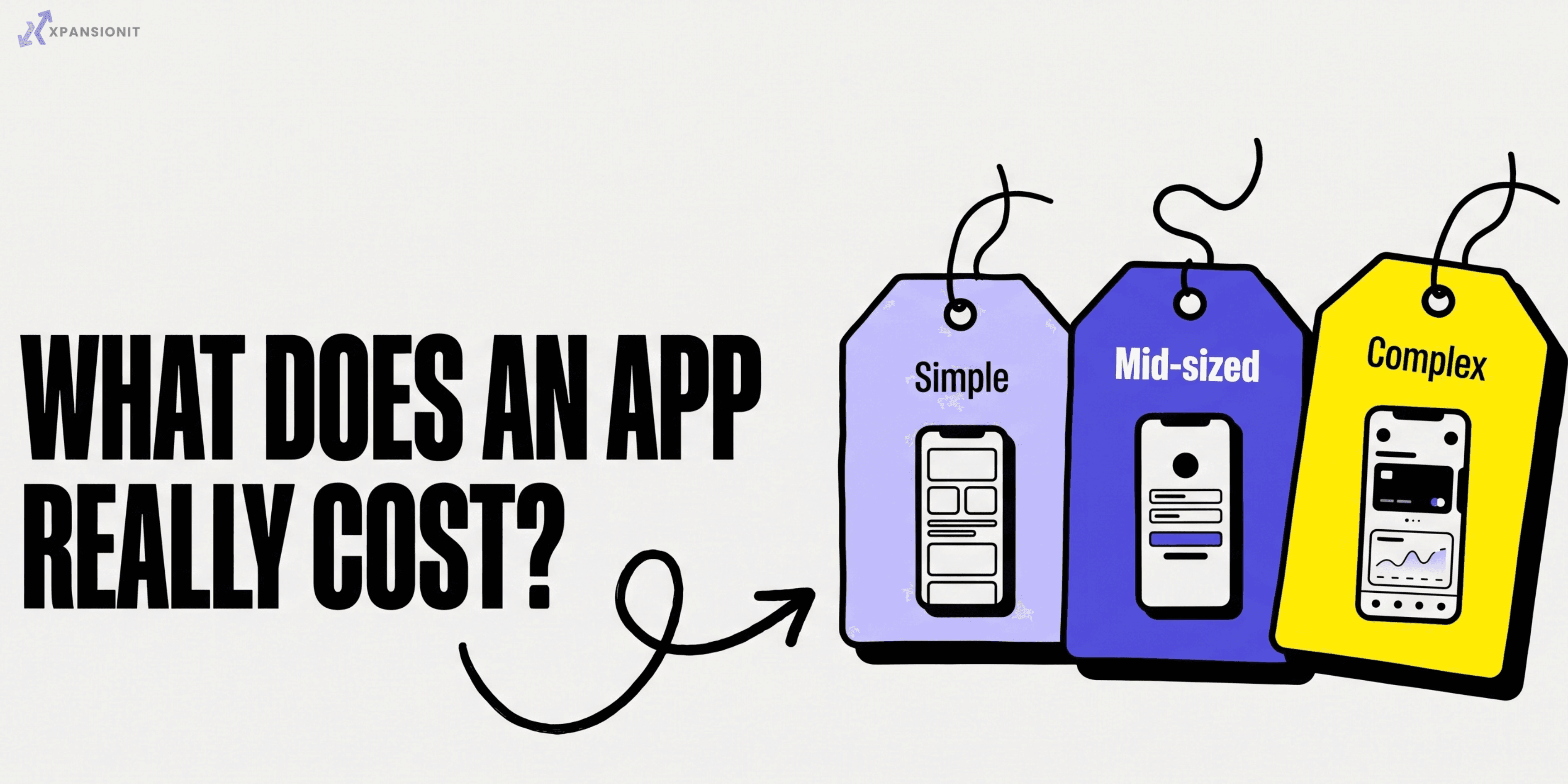
Every app is different, but most fall into one of three groups.
| Type of app | What it usually includes | Typical cost | Typical timeline |
|---|---|---|---|
| Simple | A few screens, information, a contact or booking form, no user accounts | A$20,000 to A$45,000 | 8 to 12 weeks |
| Mid-sized | User logins, profiles, notifications, a basic admin area, one or two integrations | A$45,000 to A$110,000 | 3 to 5 months |
| Complex | Payments, real-time features, several user types, a full admin system, multiple integrations | A$110,000 to A$250,000+ | 6 to 9 months |
Prices are in Australian dollars, excluding GST. If your idea sits between two groups, so will the price. The quickest way to find out where it lands is to write down what the app needs to do and get a fixed quote.
What Makes an App Cost More
The price isn't about the number of screens. It's about how much the app has to do behind them.
User accounts. As soon as people sign up and log in, the app needs secure accounts, password resets and somewhere safe to store personal details.
Payments. Taking money properly involves a payment provider, receipts, refunds and careful security. It's one of the biggest single jumps in cost.
An admin system. Most apps need a back office where you manage users, content, bookings or orders. People often forget it, but it can be as much work as the app itself.
Connections to other systems. Linking the app to Xero, your CRM, a booking system or a delivery service adds work for every connection.
iPhone, Android or both. Building both separately roughly doubles the work. A cross-platform build covers both from one codebase and usually costs much less.
Custom design. A polished, custom look costs more than a clean, simple one built from standard components. Both can look great.
Real-time features. Live chat, live tracking or anything that updates instantly for many users at once takes more engineering.
The Costs People Forget
The build is the biggest cost, but it isn't the only one.
App store fees. Apple charges an annual developer fee (US$99 a year at the time of writing) and Google charges a one-off fee (US$25). Small, but easy to forget.
Hosting and servers. Most apps need a server or cloud service running in the background. For a small app this is often a modest monthly cost, rising as you get more users.
Third-party services. Text messages, maps, email delivery and payment processing are usually charged per use.
Maintenance and updates. Apple and Google update their systems every year, and apps need updating to keep working well. A common rule of thumb is to budget around 15 to 20 percent of the build cost each year for maintenance and small improvements.
Five Ways to Keep the Cost Down
1. Start with the smallest useful version. Build the one or two features your users need most, launch, and add the rest once you know what people use.
2. Build once for both platforms. Unless your app needs something very specific to iPhone or Android, a cross-platform build saves a lot of money.
3. Ask whether you need an app at all. For many businesses, a website or web app does the job for less. We explain how to decide in Website or App: Which Does Your Business Need?
4. Get your brief clear before asking for quotes. Vague briefs lead to padded quotes and surprise extras. Our guide on how to scope a software project before getting quotes shows you what to write down.
5. Ask for a fixed price. With an hourly quote, every delay and change lands on your bill. A fixed price, agreed after the scope is clear, means you know the full cost before anything starts.
Why the Cheapest Quote Often Costs the Most
If one quote is far cheaper than the others, ask why. Usually something is missing: the admin system, testing, app store submission, or the hours that will be added later as "change requests". Other warning signs are a quote with no detail about what's included, no mention of who owns the code, and no plan for updates after launch.
A good quote tells you exactly what you're getting, how long it will take, what happens after launch, and confirms the code is yours.
Before You Ask for Quotes
Have a rough answer to each of these, and every quote you get will be more accurate:
- What problem does the app solve, and for whom?
- What are the three or four things it must do on day one?
- Does it need user accounts or payments?
- iPhone, Android, or both?
- Does it need to connect to any systems you already use?
- When would you like it live, and what budget range are you working with?
Get a Fixed-Price Quote for Your App
Tell us what you want your app to do, and we'll come back with a clear scope and one fixed price, so you know the full cost and timeline before anything starts. When it's built, the code belongs to you.
See how we approach mobile app development, or send us your idea.