How to Choose an AI Model for Your Australian Business
Ask five people which AI model your business should use and you will get five confident, contradictory answers. Claude, ChatGPT and Gemini are the names everyone knows, and each has a camp that swears by it. Here is what we tell Australian businesses who ask us: choosing an AI model for business is the wrong first question. The models are close enough, and they leapfrog each other so often, that the badge matters far less than what you build around it and where your data is allowed to live. We at XpansionIT are model-agnostic by design, so we have no dog in the brand fight. What follows is how we help clients decide, including the sovereignty question the global comparison articles never mention.
Which AI Model Is Best for Business?
There is no single winner. Use a frontier model like ChatGPT, Claude or Gemini when you need strong reasoning or polished output, a smaller or open model when cost, volume or keeping data onshore matters more, and put most of your effort into the system around the model, because that is what decides the return.
The Big Three, and What Each Does Well
Let us be fair to all three, because the honest position is that they trade the lead almost monthly and any specific benchmark you read is out of date within weeks.
ChatGPT, built on OpenAI's GPT-5 family, is the most widely used and the safest default. It is strong across general reasoning, broad knowledge and a huge ecosystem of plugins and integrations, which makes it the easy starting point for a business taking its first steps.
Claude, from Anthropic, has a reputation for writing that reads less like a robot and for careful, reliable work on code and multi-step tasks, which is why it shows up so often in developer tooling. If your use is drafting, analysis or anything agentic that has to grind through many steps without losing the thread, it is a strong pick. We go deeper on this in our guide to using Claude for business in Australia.
Gemini, from Google, leads on multimodal work, handling text, images, audio and video together, and its real trump card is how tightly it plugs into Google Workspace. If your business lives in Gmail, Docs and Sheets, Gemini often wins on convenience alone rather than on any benchmark.
The takeaway is not a ranking. It is that all three are excellent, the differences are narrowing, and picking the "wrong" one of the three is rarely what makes an AI project fail.
The Uncomfortable Truth: The Model Is the Least Important Part
Here is the finding that should change how you think about the whole question. For business use, the model is close to the least important variable. What decides the outcome is the system around it: whether it can reach your data, whether it routes questions to the right place, whether it hands off to a human at the right moment, and whether it has guardrails. A well-built AI agent wrapped around an average model beats a raw frontier model with nothing around it, every time, and businesses that deploy proper agents see meaningful automation regardless of which model sits underneath.
This is why we spend far more time on the plumbing than on the brand. Connecting a model to your actual systems is the work that pays off, which is the whole subject of AI integration for the Australian market, and when you want the system to act on its own rather than just answer, that is agentic AI. Chasing the top of the leaderboard while ignoring the system is how companies spend a lot to be disappointed.
Do Not Forget the Smaller, Cheaper Models
The big three are not your only options, and for a lot of jobs they are overkill. A new tier of small language models, along with open-weight models like Llama and Qwen, now runs cheaply, sometimes on a single machine, and beats the giants on the narrow tasks they are tuned for. For routing, data extraction, classification and routine drafting, a small model can do the job at a fraction of the cost. The sensible pattern is to use an expensive frontier model only where you need its judgement, and a cheap one everywhere else. At real volume the difference is not trivial: heavy use of a hosted frontier model can run into tens of thousands of dollars a month, where a purpose-built small model handling the same load costs a tiny fraction of that.
The Australian Question Nobody Else Answers: Where Does Your Data Live?
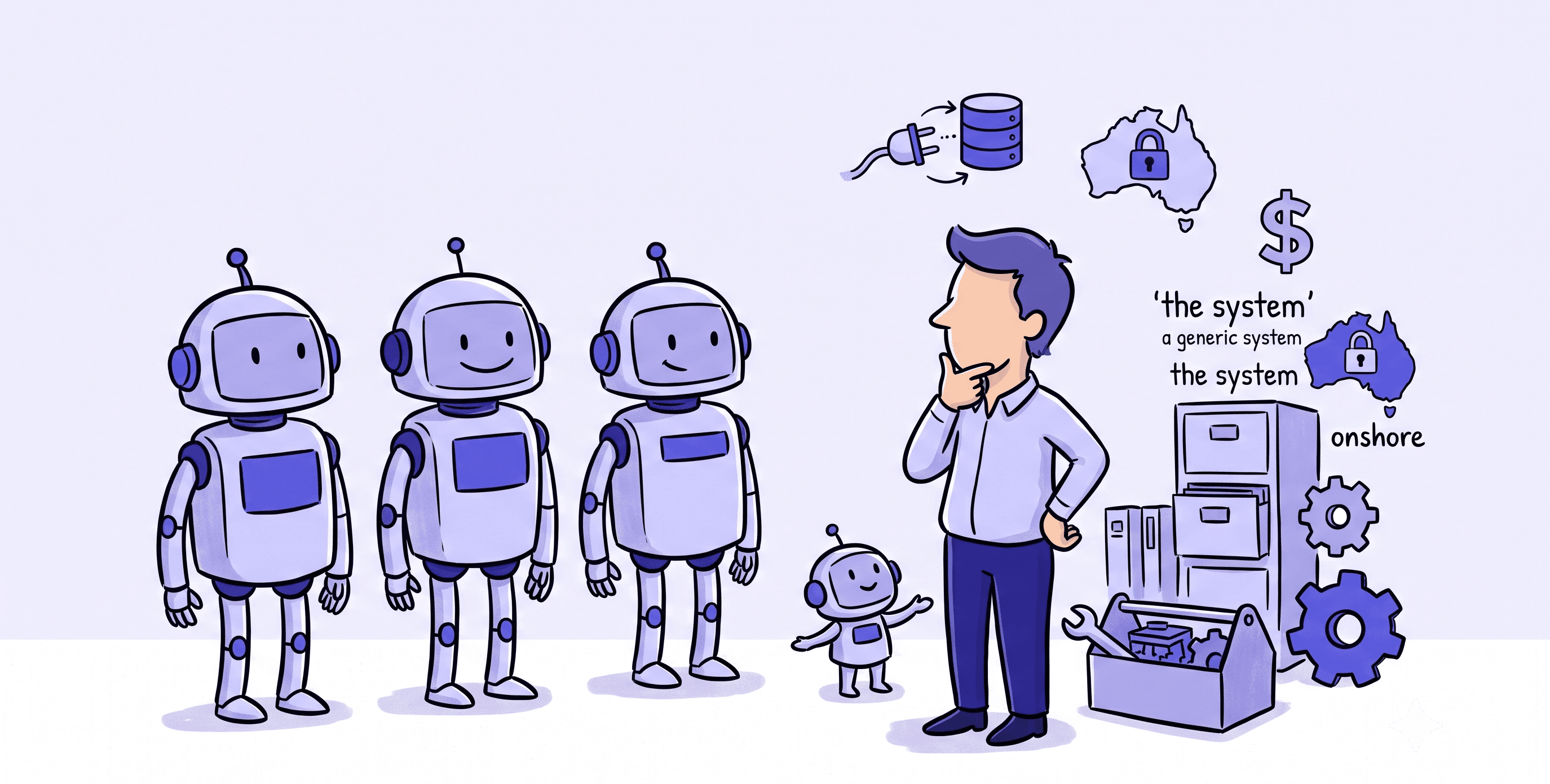
This is the part global comparison articles skip entirely, and for an Australian business it often matters more than any benchmark. If you handle customer data, and especially if you are in finance or health, you may be required to keep that data onshore. On-shore hosting has become a firm requirement for the large majority of Australian financial and healthcare organisations, tied to the Privacy Act and the security expectations of the Australian Cyber Security Centre. That single fact can decide your model for you, because it pushes you toward options that can run inside an Australian cloud region or your own infrastructure, rather than sending sensitive data offshore to whichever model tops the charts this week.
It is also why the responsible-use habits matter: keeping a human checking outputs before they reach a customer, and being able to explain what the system did. We treat data residency and governance as part of the build from day one, which is the point of doing AI responsibly in Australia and building privacy and compliance into our AI development and integration work rather than adding them at the end.
So, Which One?
The practical answer is a sequence, not a name. Start from the job and the sensitivity of the data, not the brand. Reach for a frontier model, Claude, ChatGPT or Gemini, when you need strong reasoning or polished output, and lean toward Gemini if your team already lives in Google Workspace. Use a small or open model where cost, volume or keeping data in Australia matters more. Then put the real effort into the system around whichever model you choose. And be honest about scale: if you are just drafting emails and summarising documents, the off-the-shelf version of any of the three is plenty, and you do not need us at all. You need us when the model has to plug into your systems, act on your data, and stay compliant while it does.
Most businesses that get real value end up using more than one model, matched to different jobs, rather than betting everything on a single badge.
Why This Matters to Us
We are a small Adelaide team, and being model-agnostic is a deliberate choice. We are not reselling anyone's model, so we can pick the one that fits each job, swap it out when a better one lands next month, and design the system so you are never locked to a single provider. Most of our value is not in the model at all. It is in wiring it into how your business really runs, and keeping your data where it legally needs to stay.
What Do the Numbers Say?
Australian adoption is climbing but still early, which is the opportunity. Most businesses are using AI for productivity-first, lower-risk work, and the sovereignty requirement shapes what they can safely deploy.
| What the data shows | Figure |
|---|---|
| Australian businesses using or trialling AI | over a third |
| Australian SME AI adoption, February 2026 | 44% |
| Top uses among adopters (content, data analytics) | 54% each |
| Finance and health organisations requiring onshore data | 82% |
A Quick Word From Our Own Playbook
"Do not fall in love with a model. Fall in love with the problem, then pick whichever model solves it and keep your data where it belongs."
Want to know more? Read our guide to AI integration for the Australian market.
Talk to Us
If you are trying to work out which AI model fits your business, or you have picked one and cannot get it to do anything useful, we are happy to give you a straight read. Call us on +61 420 883 221 or tell us about your project, and we will point you at the right model for the job, and tell you plainly when the free version of ChatGPT is all you need.
Whether it is a single frontier model, a cheap one for volume, or a mix wired into your systems and kept compliant, we build around the problem rather than the brand. Take a look at everything we do at XpansionIT, get to know who we are, or browse our services. If AI is the priority, start with our AI development and integration work, and when you are ready, get in touch.