How to Modernise a Legacy Application Without Blowing the Budget
There is not one way to modernise a legacy system, there are five, and most failed projects come from picking the wrong one for the situation rather than from bad engineering. We at XpansionIT modernise business systems for Australian companies, and this is the practical companion to our overview on legacy system modernisation: the actual approaches, what each costs in the Australian market, and how to choose between them. The problem is real and local. The Queensland Audit Office found in its December 2025 report that half of the systems it audited for state financial reporting are legacy systems used well beyond their lifespan and no longer supported by their vendors. That is not a government quirk, it is the quiet reality for thousands of Australian businesses.
This is general information about building software, not legal or financial advice.
What Are the Options for Modernising a Legacy System?
There are five, from least to most invasive: document and stabilise, rehost, replatform, refactor or rearchitect, and rebuild. The right one depends on how long the system needs to live, how well it is understood, and how much the business depends on it. Most successful projects mix approaches across a portfolio rather than applying one to everything.
The Five Approaches, Plainly
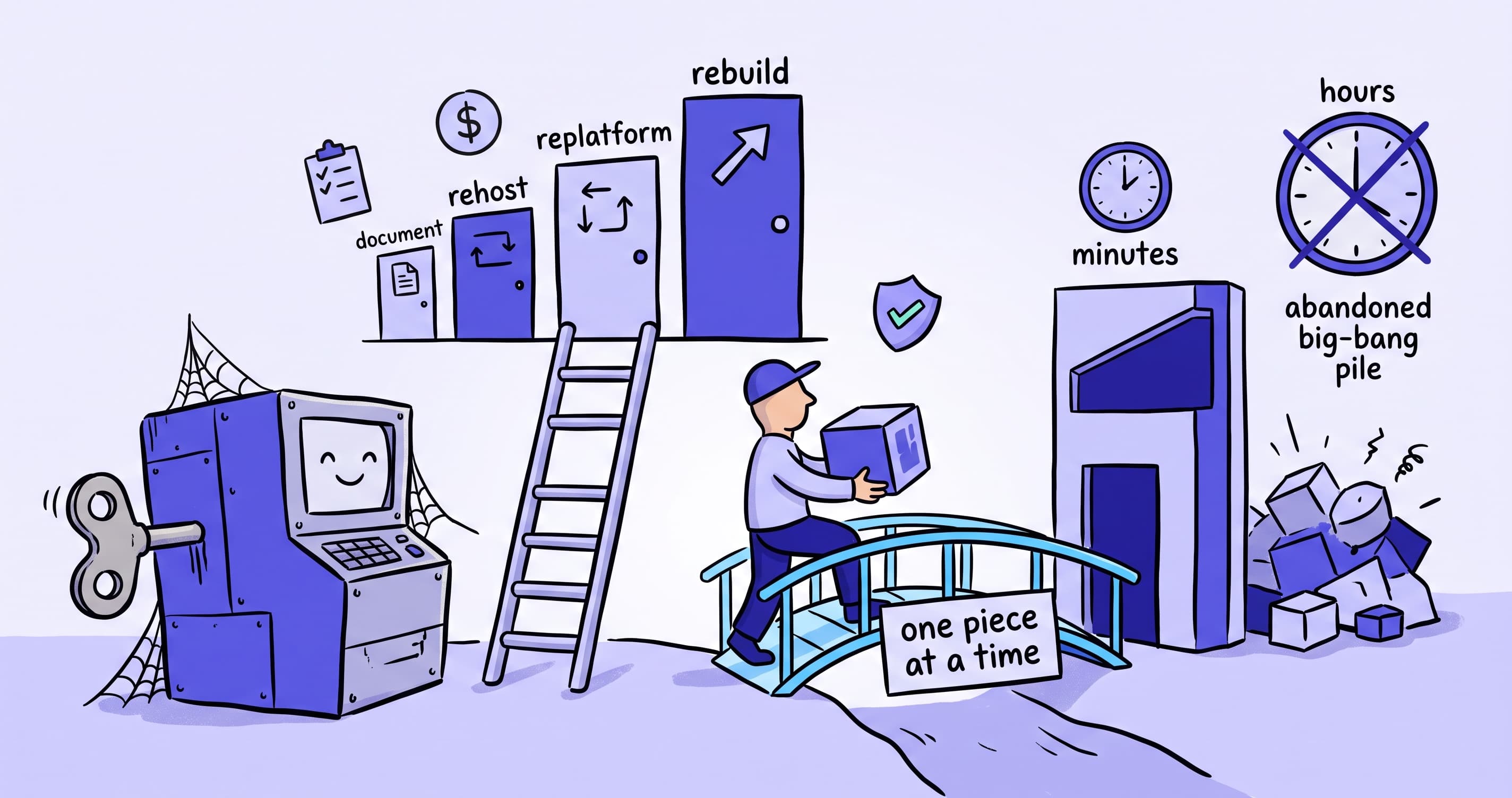
Think of these as a ladder. The higher you climb, the more you gain and the more you risk, so climb only as far as the situation needs.
Document and stabilise. For a system that will live another three to five years and mostly needs its risk reduced, the job is to understand and document it so it no longer depends on one person's memory. It is weeks of work, not months, and it buys you time and safety cheaply.
Rehost. Lift and shift the system to modern infrastructure with no code changes. Lowest risk and cost, quick to deliver, and it cuts hosting and support pain, though it does not fix the software itself.
Replatform. Move to managed infrastructure with light changes, for example shifting a database to a cloud equivalent and adding a deployment pipeline. Low risk, real operational gains, still no deep rewrite.
Refactor or rearchitect. Improve the code structure, or change the fundamental design, so the system can grow again. Medium to high risk, and where the durable improvements usually live.
Rebuild. Replace the system, but incrementally using the strangler pattern, wrapping the old system and replacing one piece at a time. Full big-bang rewrites should be a last resort, reserved for systems that cannot be understood or tested. If you are not sure which path your system needs, start with our legacy system assessment: repair or replace guide.
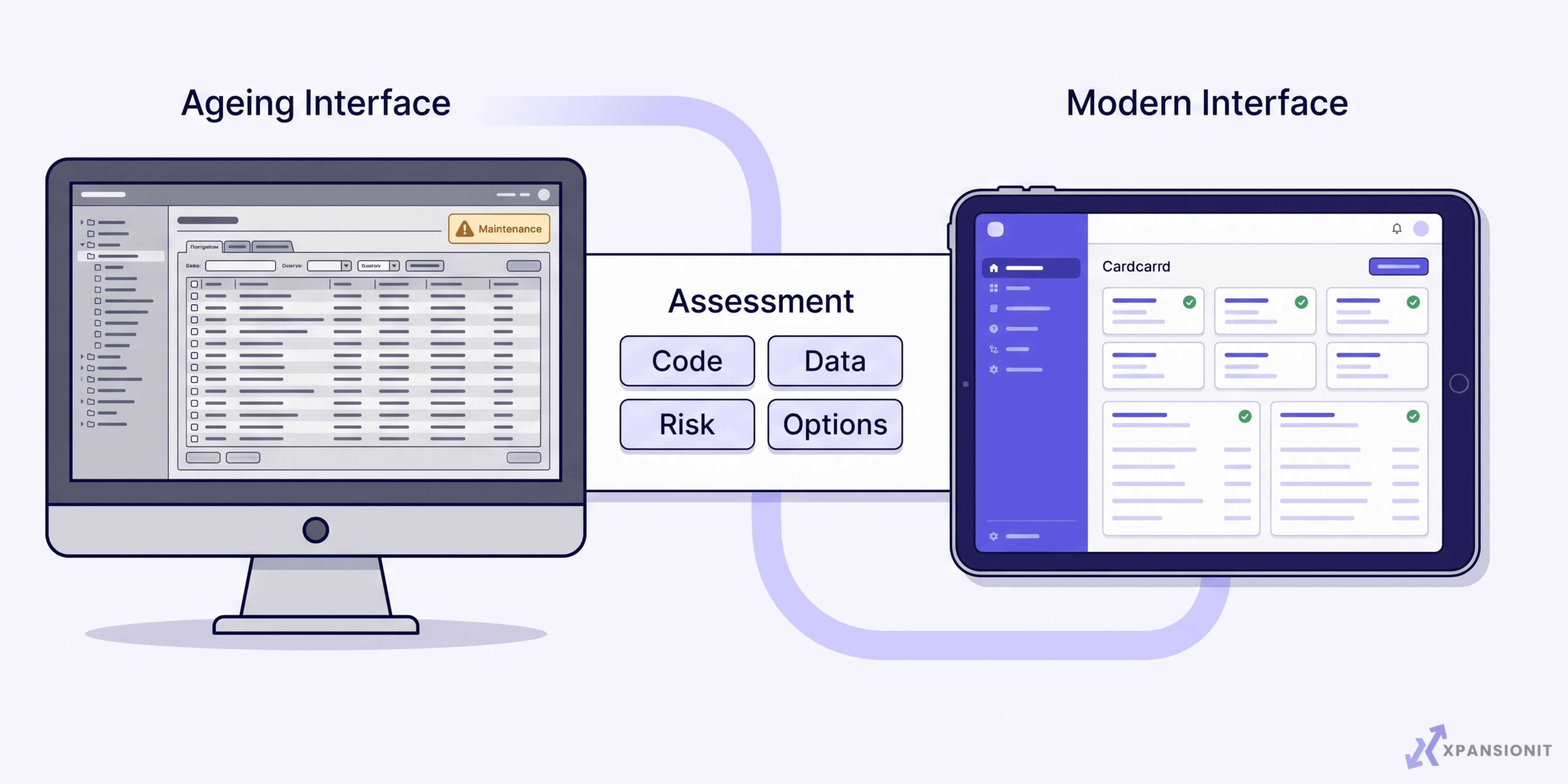
The discipline that separates success from failure is scoring each application against these five before touching any code, rather than defaulting to the most dramatic option. That maps neatly onto the buy-versus-build thinking in our note on low-code versus custom software: match the tool to the situation, do not over-build.
Why Incremental Beats Big Bang, Every Time
If there is one thing worth internalising, it is this. Big-bang rewrites look faster and cleaner on a project plan, which is exactly why businesses keep choosing them, and the evidence keeps punishing them for it. Industry analysis found that the large majority of modernisation projects fail or underperform, and failed programmes typically burn 18 to 36 months before being abandoned or scaled back, often leaving the business further behind than when it started.
The incremental strangler pattern avoids this by running the old and new systems in parallel and cutting over one component at a time. The difference is measurable: incremental cutover has averaged around 0.3 hours of downtime against 4.2 hours for traditional big-bang migrations, and if a new module misbehaves you route traffic back to the old one in minutes rather than triggering a crisis. It is slower on paper and far safer in reality, which is the trade every sensible business should take for a system it depends on. This is the same phased logic we bring to taking software from prototype to production.
What It Costs in Australia
Here are honest ranges rather than a single number, because the real figure comes from a discovery engagement, not a guess. For most Australian mid-size businesses in 2026, a scoped legacy modernisation project falls between roughly 70,000 and 700,000 dollars. A targeted rehost or replatform sits at the lower end. A significant refactor or rearchitect sits higher. Enterprise projects with large, interconnected systems regularly pass a million.
Timeline tracks the approach: a documentation pass is six to ten weeks, a rehost eight to fourteen, a refactor in place twelve to twenty-two, a replatform twenty to thirty-six, and an incremental rebuild six months to a year or more. Two honest warnings the vendor demos leave out. Legacy projects consistently run over their initial estimates, so a quote with no contingency has been optimised to win the deal, not to be accurate. And the biggest hidden cost is undocumented business logic, the rules buried in old code that nobody wrote down. A realistic plan budgets for discovering those rather than pretending they do not exist. Our breakdown of what custom software costs in Australia covers the general drivers.
Where AI Helps, and Where It Overpromises
AI does speed parts of this up. Automated dependency mapping, code translation, and test generation have cut modernisation timelines by an estimated 40 to 50 per cent compared with a few years ago, and AI is especially useful for extracting and documenting the business rules hidden in legacy code. That is real, and we use it.
The overpromise is believing AI does the whole job. Analysts have warned that most mainframe-exit projects started in 2026 will miss their goals, largely because organisations overestimate what AI migration tools can do automatically. AI accelerates the work, it does not replace the architect who decides what the system should become or the domain expert who knows what must not break. Treated as an accelerator with humans in charge, it is a genuine advantage. Treated as autopilot, it is how you produce a fast, confident, wrong migration.
A Note on Where You Are
Because these queries come from all over the country, one practical point. Modernisation is not a location-bound service, the work is done wherever the right team is, and a good partner runs it remotely with disciplined phases and clear checkpoints. Whether your ageing system sits in Brisbane, Sydney, Melbourne, or Adelaide, what matters is the approach and the safety net, not the postcode of the developer. We are an Adelaide team and we work with businesses across Australia the same careful way regardless of where the system lives.
When You Should Not Modernise Yet
Since we do this work, we will be straight about when to wait. If the system works well, is cheap to run, carries low security and compliance risk, and the people who maintain it are not leaving, document it and leave it alone. Not every old system is a liability. The honest test is whether it is costing you more than it returns, in money, risk, or missed opportunity, and whether that gap is widening. And if a builder proposes a two-year, all-or-nothing rewrite as the only option, get a second opinion, because there is almost always a smaller, safer first step.
Why This Matters to Us
We are a small Adelaide team, and modernisation is a large part of what we do, so we have seen both the good version and the wreck. The wreck is always the big-bang rewrite that ran for two years and quietly fell apart. The good version is unglamorous: score the portfolio, pick the least invasive approach that solves the problem, wrap the old system, replace it a piece at a time, and keep the business running throughout. We would rather ship a working improvement every few weeks than ask anyone to hold their breath for a year and hope.
What Do the Numbers Say?
The pattern across the 2026 research is consistent: incremental modernisation is cheaper, safer, and far more likely to finish than the big-bang rewrite it replaces.
| What the data shows | Figure |
|---|---|
| Modernisation projects that fail or underperform | 68 to 79% |
| Downtime, incremental cutover vs big-bang | 0.3 vs 4.2 hours |
| Infrastructure cost cut after cloud modernisation | 30 to 50% |
| Timeline saving from AI-assisted modernisation | 40 to 50% |
A Quick Word From Our Own Playbook
"The most expensive modernisation is the big-bang rewrite that runs for two years and then quietly gets cancelled. Replace one piece at a time and you never bet the business."
Want to know more? Read our overview of legacy system modernisation in Australia.
Talk to Us
If you have an ageing system you are nervous about, we are happy to score it against the five approaches and tell you which one fits, and roughly what it would cost, before you commit to anything. tell us about your system, and we will give you a straight read, not a two-year sales pitch.
Whether your system needs a few careful repairs, a gradual rebuild, or no changes yet, we will help you choose the safest next step. We improve one part at a time so your business can keep running while the work is done. If an ageing system is becoming harder to maintain, explore our legacy system modernisation service or tell us what is happening. We will review the problem and explain your options in plain language.