What Legacy System Modernisation Means
How to Modernise Legacy Software in Australia Without a Big-Bang Rebuild
Most Australian businesses do not have a legacy system problem. They have a legacy system they have quietly learned to live with. The old platform still runs payroll, still takes orders, still works, so nobody touches it. Legacy system modernisation is the unglamorous business of fixing that before it fixes you. We at XpansionIT do this kind of work, and the first thing worth saying is that modernising legacy software almost never means the dramatic full rewrite people fear. The cost of an old system is real, but it is mostly hidden, and the smart way to deal with it is rarely to burn the whole thing down. Here is how to think about it.
What Is Legacy System Modernisation?
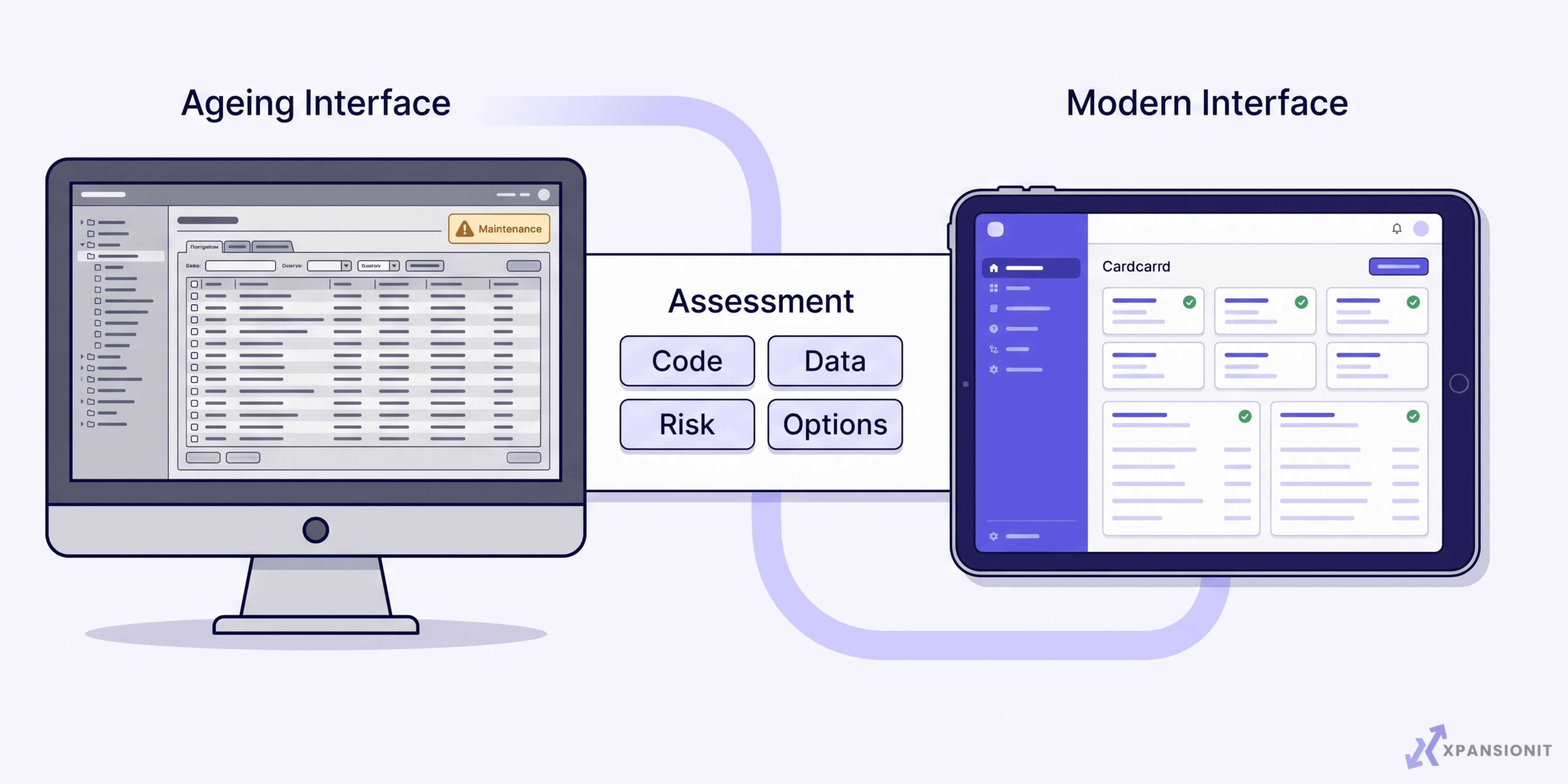
It is the process of updating, re-architecting, or replacing outdated software so it can be maintained, integrated, and scaled again. A legacy system is any software that can no longer be updated, connected to modern tools, or grown to meet demand, regardless of its age. Some ten-year-old systems are fine. Some are already holding you back.
The Real Cost of Standing Still
The reason legacy systems survive is that they look cheap. The invoice is small and familiar, so the system feels like a solved problem. It is not. Across the industry, organisations spend somewhere between 60 and 80% of their IT budget just keeping existing systems alive, which leaves very little for anything new. Worse, most businesses undercount that spend by 40 to 60%, because the true cost is scattered across engineers writing workarounds, end-of-life vendor fees, and the occasional outage, rather than sitting in one tidy line called "legacy".
Then there is the compounding part. Technical debt grows at roughly 20% a year if you ignore it, so a problem worth one dollar today is worth two in under four years. The people who understand the old code retire or move on, taking undocumented business rules with them. Security exposure climbs, because unpatched software is exactly what attackers look for. And the newer ambitions, connecting to a modern tool, adding analytics, layering on AI, quietly stall because the old architecture cannot support them. If you have ever been quoted a fortune to make two systems talk to each other, you have already met this cost. Our breakdown of what custom software costs in Australia is a useful companion here, because the maintenance invoice is only ever half the story.
You Do Not Have to Rewrite Everything, and You Probably Should Not
The instinct, once the pain is obvious, is to start again from scratch. Resist it. Full rewrites of a working system typically take 36 to 48 months before they return anything, and during that whole window you pay twice: once to keep the old system running because you cannot switch it off mid-project, and once to fund the rebuild. Requirements drift, budgets blow out, and a worrying share of these programmes never land as promised.
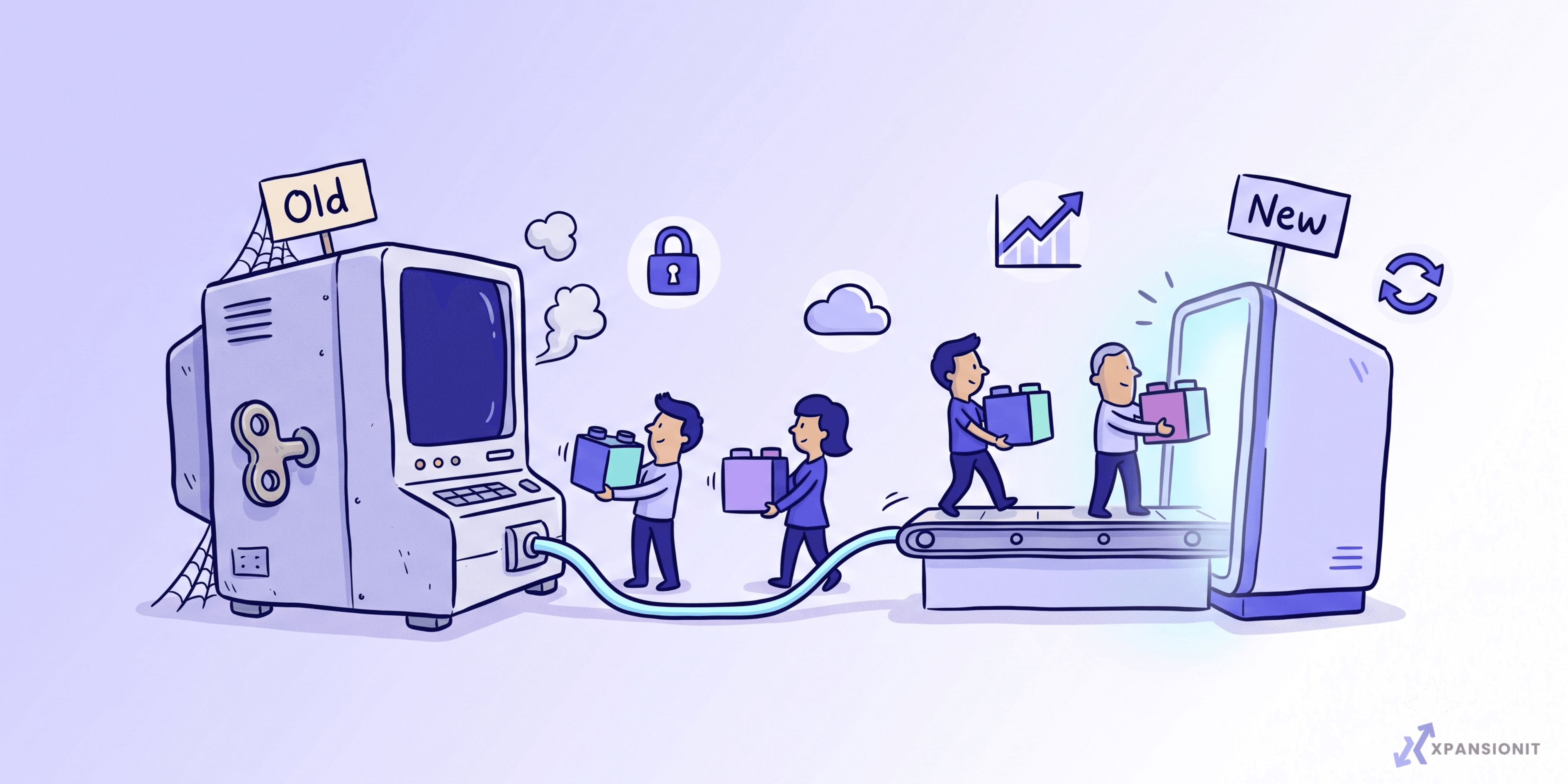
The approach that works is incremental. You wrap the old system, replace one piece at a time, and run the old and new side by side until each new piece is trusted, then retire the old part. It is often called the strangler pattern, and it means there is never a single terrifying switch-over. Each stage delivers a real improvement and a real saving, so the project funds its own next step instead of asking for a blank cheque up front. Sometimes the right move for a given component is not to rebuild it at all but to re-platform it, refactor it, or simply retire it. Our piece on outgrowing WordPress and moving to custom code is really a small, specific version of this same story, and if the answer is a cleaner architecture, that is where SaaS architecture work comes in.
How to Modernise Without Breaking the Business
A few habits separate the modernisations that go well from the ones that become horror stories.
Start with a cost and priority map, not code. Before anything is touched, work out which systems cost the most to run, which carry the most compliance risk, and which the fewest people understand. Modernise the high-cost, high-value ones first.
Treat data migration as its own product. Define what "complete and correct" looks like before you move a single record, because data failures are expensive and hard to undo.
Turn tribal knowledge into tests. Where the only documentation is a person's memory, capture those business rules as automated tests, run them against the old system first, then the new one, and prove nothing was lost.
Design for rollback from day one, and measure outcomes rather than milestones. "We migrated the billing module" is a milestone. "Billing errors fell and support time dropped by half" is an outcome. For a sense of how a healthy build moves, our note on taking software from prototype to production applies just as well to a rebuild, and where the destination is the cloud, that is a cloud migration in its own right.
When Modernising Unlocks AI
There is a bonus most businesses miss. The clean data pipelines and modern APIs that a good modernisation produces are exactly what artificial intelligence needs to be useful. You cannot bolt meaningful automation or analytics onto a system that cannot expose its data. This is why so many AI projects stall at the proof-of-concept stage: the model is fine, the plumbing is not. Modernise first and the AI work that follows becomes far cheaper, which is the practical point behind our guide to AI integration for the Australian market.
When Not to Modernise Yet
Since we build these systems, it would be easy to tell you everything old must go. That is not true. If a system truly works, is cheap to run, carries low security and compliance risk, and the people who maintain it are not going anywhere, then leaving it alone is the right call. Not every old thing is a liability. The honest test is whether the system is costing you more than it returns, in money, risk, or missed opportunity, and whether that gap is widening. A focused first phase, modernising a single high-cost system, usually starts in the low tens of thousands and pays for itself in reduced maintenance well before the next phase begins. If a builder proposes a two-year, all-or-nothing rewrite as the only option, get a second opinion. There is almost always a smaller first step.
Why This Matters to Us
We are a small Adelaide team, and a fair amount of our work is exactly this: inheriting a system someone else built, or that grew up organically over a decade, and carefully bringing it into the present without taking the business offline. We have seen what the big-bang approach does to a company, and we would rather ship a working improvement every few weeks than ask anyone to hold their breath for two years. Modernisation done properly is calm, not dramatic. That is the version we like.
What Do the Numbers Say?
The pattern is remarkably consistent across the major analyses. Most IT budgets are dominated by simply keeping old systems running, and the businesses that modernise report real, repeatable savings once they do, not to mention faster release cycles and fewer outages. The cost of staying still, meanwhile, only compounds.
| What the data shows | Figure |
|---|---|
| Share of IT budget spent maintaining legacy systems | 60 to 80% |
| Infrastructure cost cut reported after modernisation | 30 to 50% |
| Operating cost reduction from phased modernisation over three years | 25 to 40% |
| CIOs who say legacy is the main barrier to transformation | 73% |
A Quick Word From Our Own Playbook
"Nobody regrets modernising one system at a time. Plenty of people regret trying to modernise all of them at once."
Want to know more? Read the software development options in Australia.
Talk to Us
If you have a system you are quietly nervous about, the one nobody wants to touch, we are happy to take a look and tell you whether it is worth modernising, and if so, where to start. Call us on +61 420 883 221 or tell us about it through our contact page, and we will give you a straight read, not a two-year sales pitch.
Whether it needs a light refactor or a staged rebuild, we work in phases so the business keeps running and every step earns its keep. Take a look at everything we do at XpansionIT, get to know who we are, or browse our services. If an ageing platform is the problem, start with our legacy system modernisation work or our broader custom software development service, and when you are ready, get in touch.