What Low-Code and Custom Software Each Do Well
Low-Code vs Custom Software: How Australian Businesses Should Choose in 2026
Someone at a barbecue tells you their nephew built a whole app in Bubble for a few hundred dollars a month. Your developer quote says eighty thousand. So which is right? Low-code vs custom software is the question almost every Australian business now faces, and the honest answer is that both camps oversell their side. Low-code is faster and cheaper than a custom studio will admit. Custom is more necessary than a low-code salesperson will ever tell you. We at XpansionIT build custom software for a living, so we will be upfront about our bias, and then tell you the cases where we would happily send you to a low-code tool instead. Here is how the choice really breaks down.
What Is the Difference Between Low-Code and Custom Software?
Low-code lets you build applications visually on a third-party platform, quickly and cheaply, but you rent the result and usually cannot export the underlying code. Custom software is built from scratch in standard languages, so you own it, control it, and can scale it without limits, though it costs more and takes longer up front.
Where Low-Code Wins
Let us give low-code its due, because it earns it. For the right job, it is the smart choice, and the numbers are not close. Low-code can shave 40 to 60% off the cost of a standard business application and deliver it two to three months faster than a from-scratch build. That is why, by 2026, an estimated 75% of new business applications use some form of low-code or no-code tooling, up from under a quarter just six years ago.
Where does it shine? Internal tools, workflow automation, dashboards, forms, and departmental apps: the unglamorous software that runs a business behind the scenes. If your CRM almost does what you need but misses one step, a low-code layer is often the fastest fix, which is the same instinct behind our guide on what to automate first. And with Australia short hundreds of thousands of developers, using low-code to handle internal tooling frees your scarce engineering time for the work that truly differentiates you. It is also the ideal way to test an idea cheaply before committing, the exact logic we lay out in how to build a micro SaaS.
Where Low-Code Hits a Wall
Now the part the platforms play down. Low-code trades flexibility for speed, and that trade has a bill that arrives later. Roughly 78% of enterprise-grade low-code projects eventually need custom code brought in to get past a limitation the platform cannot handle. The walls are predictable. Performance degrades once you push past five to ten thousand concurrent users, with generated apps often running noticeably slower than a custom equivalent. Complex or unusual business logic becomes painful to express in a visual builder. Regulated or sensitive data strains against a platform's one-size-fits-all security model.
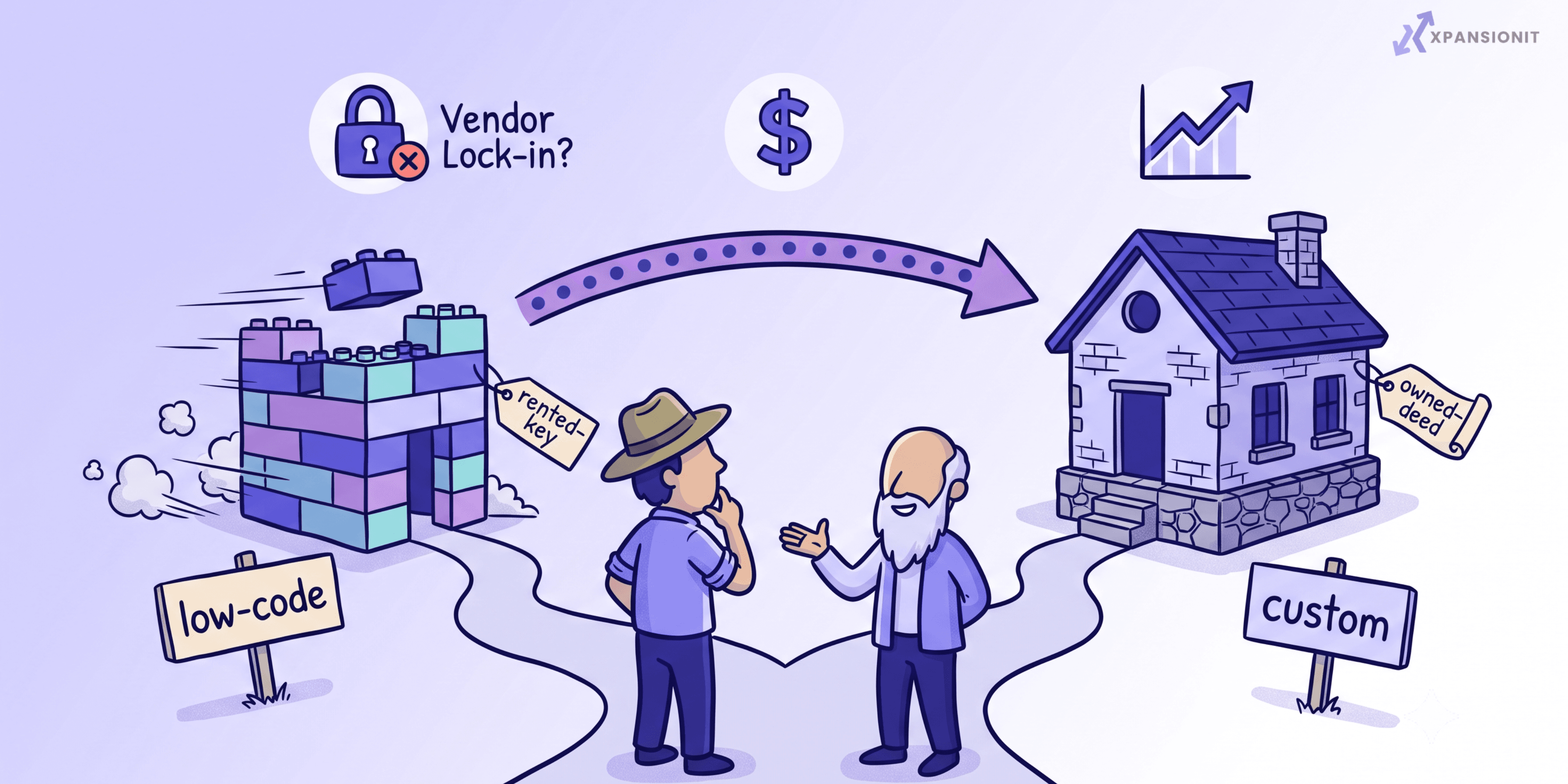
Then there is the big one: vendor lock-in, which around 37% of organisations name as a leading risk. Because most platforms will not let you export working code, the day the vendor triples its price, changes its terms, or shuts down, you are not negotiating, you are rebuilding from scratch. That is the same trap as any outgrown tool, and it is exactly the story we tell in outgrowing WordPress and moving to custom code. Building your core product on someone else's platform means your most valuable asset lives in a house you do not own.
The Cost Picture Over Time
Low-code looks cheaper because you are only ever shown month one. A build might land at $30,000 to $80,000 against $80,000 to $200,000 for custom, and the subscription looks harmless at $25 to $200 per user per month. But those per-user fees climb as you grow, and a successful app can see its running costs balloon exactly when you can least afford the surprise. Custom software flips that shape: more up front, then predictable, and you own the asset outright with no subscription clock ticking. For most medium-sized applications with a stable user base, the two paths cross somewhere around year three or four. We break the drivers down in what custom software costs in Australia, and the short version is that the cheapest option on day one is rarely the cheapest option by year four.
The Move Most Smart Businesses Make
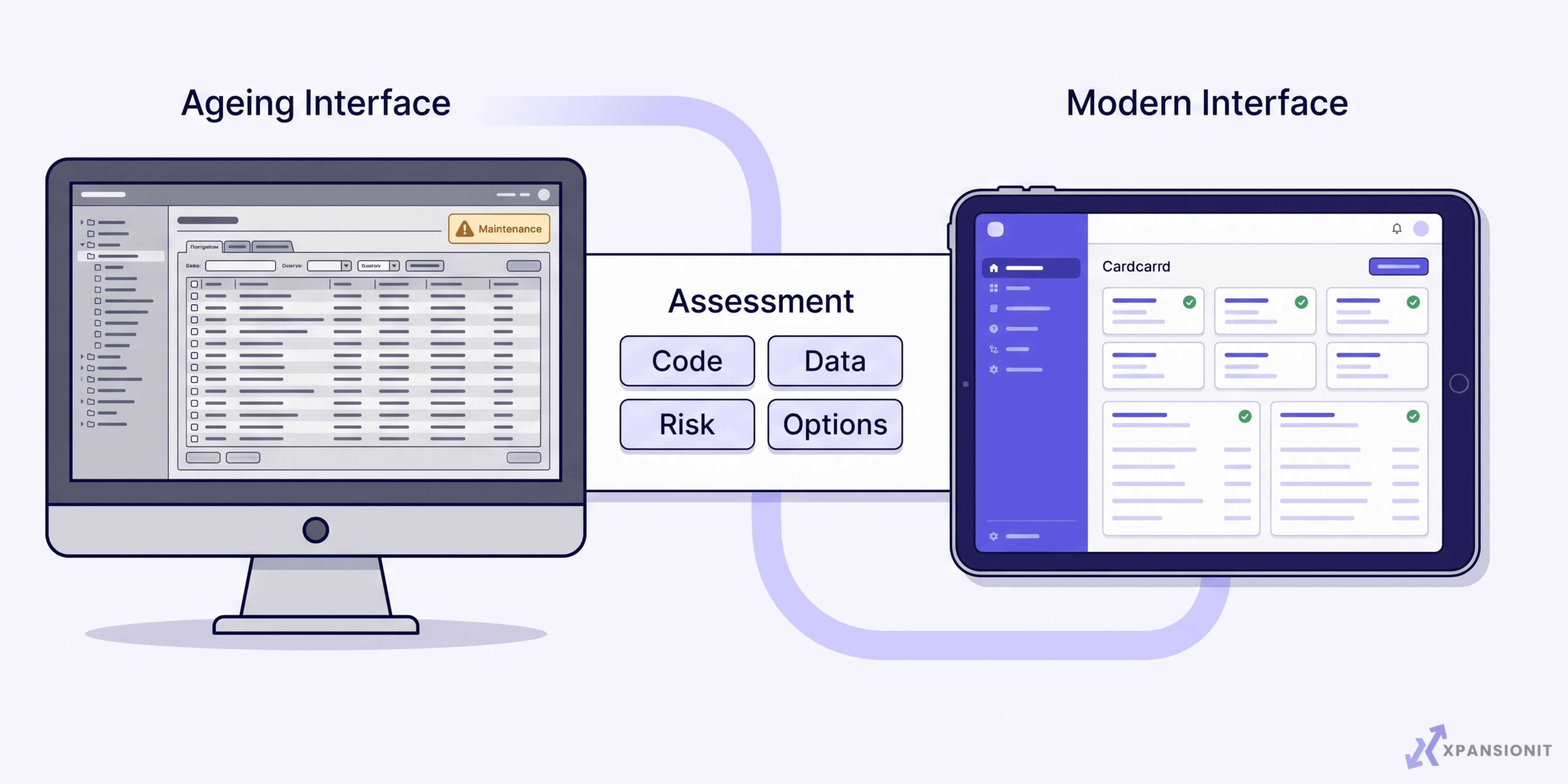
Here is the part that resolves the whole argument: in 2026, the winning answer is usually not one or the other. It is a sequence. Validate fast and cheap with low-code or no-code, get real users, confirm people want what you are building, and then rebuild the core in custom code once the requirements are proven and stable. You get low-code's speed for learning and custom's durability for scaling, and you never bet the company on a platform you might outgrow in eighteen months. The rule of thumb we give clients is simple: prototype on rented land, but build the house you plan to live in on land you own. When it is time to make that jump, our note on taking software from prototype to production covers the move, and getting the SaaS architecture right is what makes it scale.
A Quick Word on AI-Generated Code
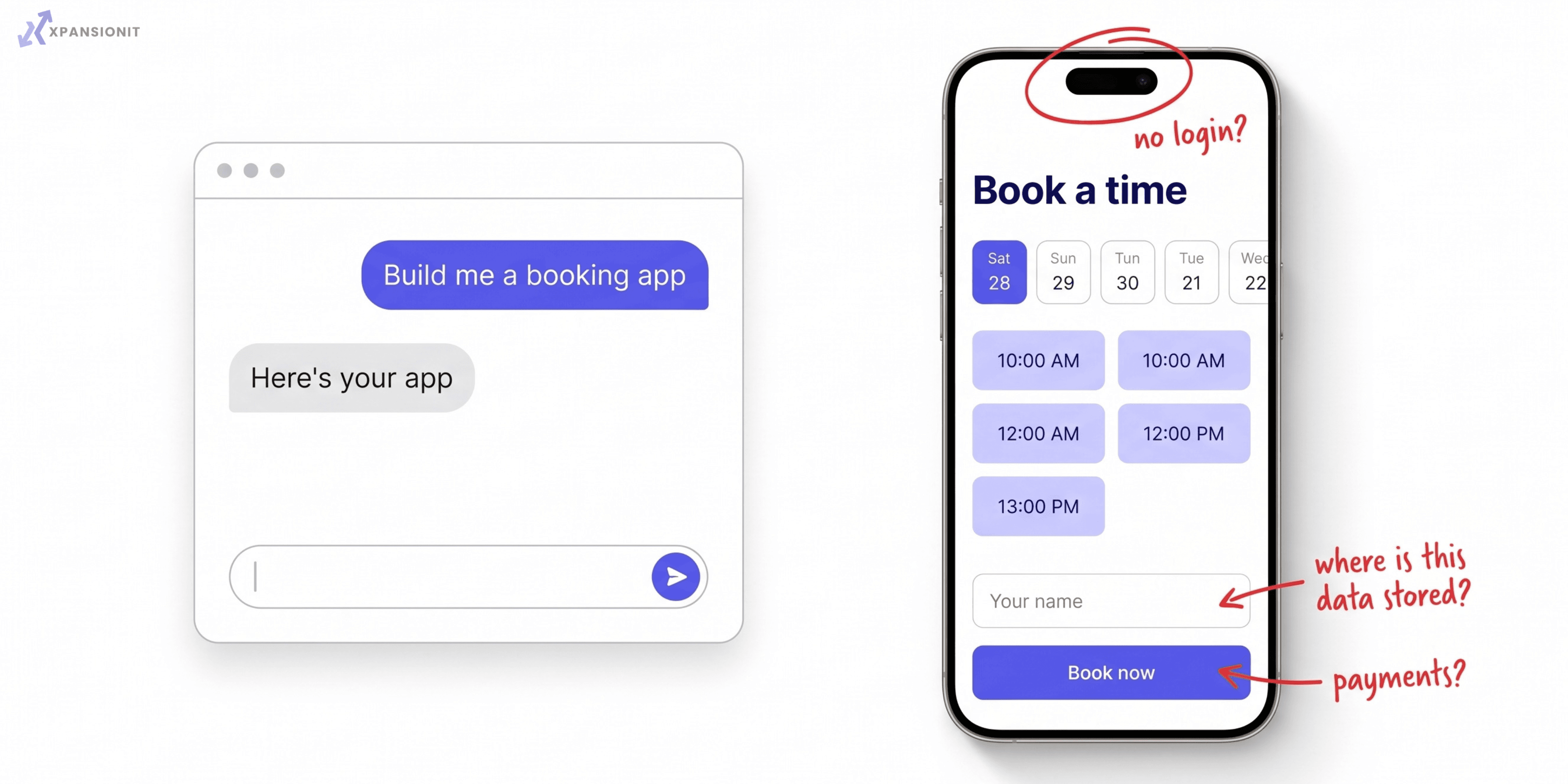
There is now a third path worth knowing about. AI coding tools can generate real, standard code, in frameworks like Next.js, that you own outright, giving you close to low-code speed without the lock-in. The catch is quality: independent studies have found a meaningful share of AI-generated code contains security flaws, and those flaws are usually invisible until an experienced developer reviews the build. Used with proper oversight it is a genuine accelerator. Used unsupervised on anything customer-facing, it is a liability waiting to be discovered. We use these tools daily, always with a human reviewing what ships.
When Low-Code Is the Right Call, and We Will Tell You So
Since we sell custom software, take this with the appropriate pinch of salt, but we mean it. If you are automating an internal process, building a departmental tool, working to a tight budget and timeline, or testing whether an idea has legs at all, low-code is very likely the right answer, and we will tell you so rather than sell you a build you do not need. The moment to choose custom is when the software is customer-facing and central to your business, when you expect real scale, when you handle regulated or sensitive data, when the software itself is your competitive advantage, or when ownership matters for raising money or selling the business. If none of those apply yet, save your money.
Why This Matters to Us
We are a small Adelaide team, and a steady share of our work is rescuing businesses that built their core on a platform they later outgrew, then had to rebuild under pressure. It is an expensive way to learn the lesson. We would rather have the honest conversation at the start, point you to low-code when that is the smart move, and be there to build custom when you have earned the need for it. A partner who only ever recommends the thing they sell is not much of a partner.
What Do the Numbers Say?
The pattern across the research is clear. Low-code has become the default for building software, and for the right project it delivers real savings. But a large majority of serious builds eventually hit a ceiling, and lock-in remains the risk businesses most often regret ignoring.
| What the data shows | Figure |
|---|---|
| New business apps using low-code or no-code by 2026 | about 75% |
| Cost saving low-code can deliver on the right project | 40 to 60% |
| Enterprise low-code projects that later need custom code | 78% |
| Organisations citing vendor lock-in as a top risk | 37% |
A Quick Word From Our Own Playbook
"Prototype on rented land. Build the house you plan to live in on land you own."
Want to know more? Read the software development options in Australia.
Talk to Us
If you are staring at a low-code tool and a custom quote and cannot tell which is right, we are happy to give you a straight read, including telling you when low-code is all you need. Call us on +61 420 883 221 or tell us about your project, and we will help you match the approach to what you are really building.
Whether the answer is a quick low-code fix, a proven idea ready for a real build, or a hybrid of the two, we will help you get there without the expensive detour. Take a look at everything we do at XpansionIT, get to know who we are, or browse our services. If you are ready for something you will own and can scale, start with our custom software development service, and when you want to talk it through, get in touch.