
How Do You Build a Vertical SaaS Product?
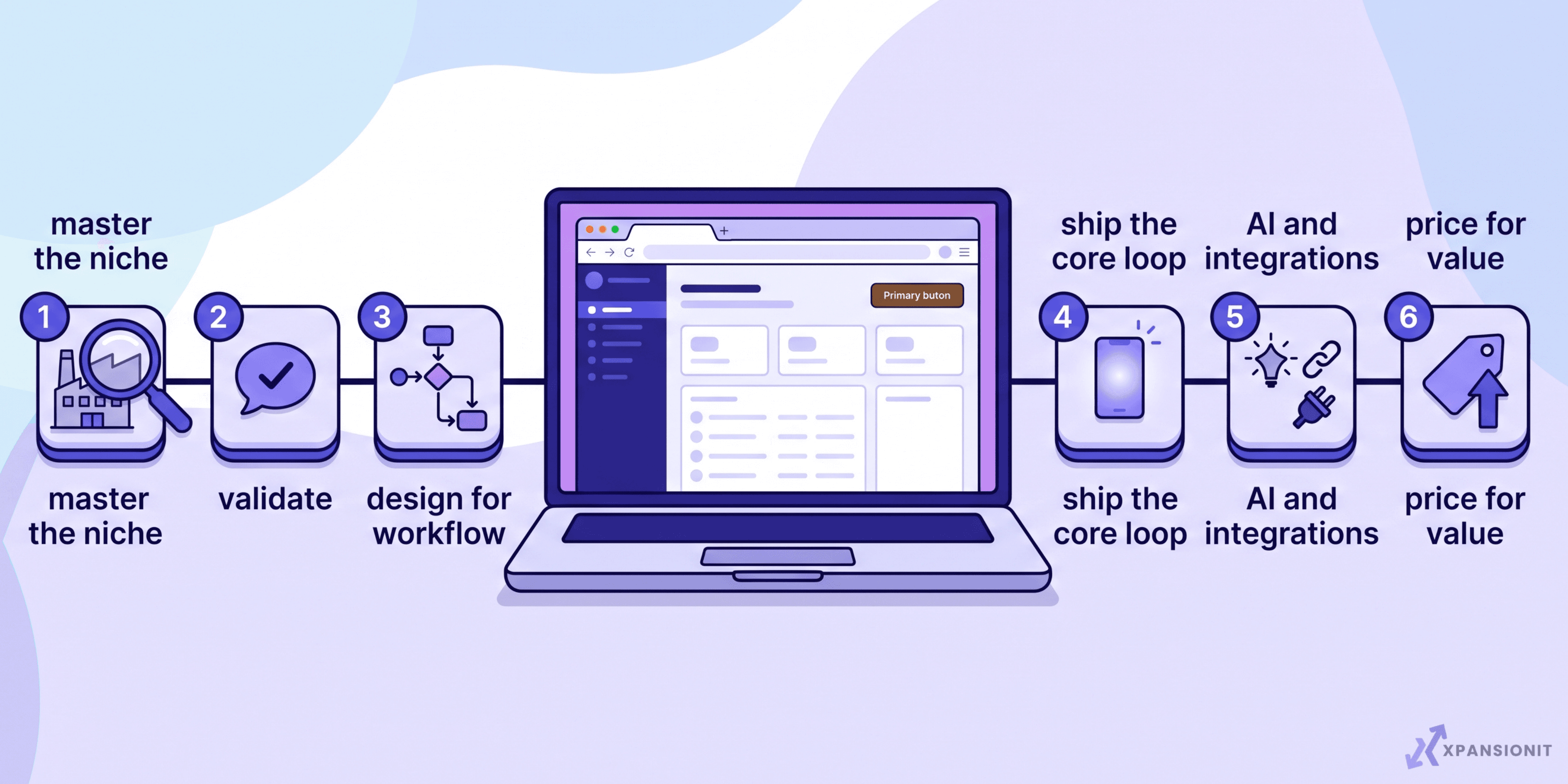
In order: master the niche, validate the problem with real operators before you write code, design around the industry's real workflow rather than a generic one, ship a focused MVP that nails one core job, build AI and integrations in from the start instead of bolting them on, and price for the value you deliver. Domain knowledge matters more than feature count, and the biggest failures all come from doing these out of order, usually by building first and validating never. We at XpansionIT build vertical software for Australian businesses, so this is the framework we use in practice, written for a founder or an operator who has spotted a real problem in an industry they understand. If you have not yet worked out whether your niche is worth it, start with the most defensible vertical SaaS niches and come back here once you have.
Start With the Niche You Already Understand
The best vertical SaaS is built by people who know the industry from the inside, because the whole advantage of going vertical is depth that outsiders cannot fake. If you have spent years in an industry and keep seeing the same broken process, that lived knowledge is your unfair advantage, and it is worth more than any feature list. If you are coming from outside, your first job is to buy that knowledge with time: talk to operators, sit with the workflow, learn the language. A generic tool built by someone who does not understand the work is exactly what vertical SaaS beats, so do not become the thing you are trying to replace. This is the difference between a real vertical product and a horizontal tool with an industry logo on it, which is the distinction we draw in what vertical SaaS really is.
Validate Before You Build Anything
This is the step almost everyone skips, and skipping it is the single most expensive mistake in software. Before a line of code, confirm three things with real people who do the work every day: that the problem really hurts, that they are already spending time or money trying to solve it, and that they would pay for a better answer. Talk to operators, not to friends who will be polite. Pre-sell if you can, a signed intent or a deposit is worth more than a hundred enthusiastic "that sounds great" replies. If you cannot find people who feel the pain sharply enough to pay, the answer is not to build anyway and hope. It is to keep looking until you find the pain that is worth solving. Building before validating is how good developers produce beautiful products nobody wants.
Design for Their Workflow, Not a Generic One
Once the problem is real, shape the product around how the industry really operates, including the unglamorous parts: its compliance obligations, its reporting quirks, the specific sequence people work in. This is where vertical wins, because a generic tool forces the industry to bend to the software, and a good vertical tool bends to the industry. Map the real workflow before you design a single screen. The compliance and reporting depth that feels like a burden is in fact your moat, since it is exactly what a generalist competitor will not bother to build. If your niche is regulated, design that in from the start rather than retrofitting it, which is the same lesson we set out in healthcare software development, one of the most compliance-heavy verticals there is.
Ship One Core Loop as Your MVP
Every SaaS product has one action that delivers most of the value, the core loop a user comes back to do again and again. Your first version should do that one thing well and almost nothing else. Resist the pressure to add "just one more feature," because feature creep is what turns a three-month build into a two-year one that still has not launched. Keep the technology boring and proven, you do not need microservices or elaborate architecture for your first users, and overengineering for a scale you have not reached yet is its own kind of procrastination. Build the smallest thing that delivers the outcome, put it in front of real users, and iterate on what they show you rather than what you imagined. Our guide on building a micro SaaS covers this validate-small approach, and taking a SaaS from prototype to production covers what has to change once the idea is proven.
Build AI and Integrations In, Not On
In 2026, operators expect two things as standard: intelligent features that save them work, and connections to the tools they already run. Both need to be planned from the start, not bolted on later. But there is a trap here worth naming plainly: a product that just passes a user's request to a general AI model and hands back the answer is not a business, it is a feature someone will copy. The value in a vertical SaaS is your data and your workflow, the AI should be trained on or wrapped around the industry-specific knowledge only you have accumulated. Integrations matter just as much, because a tool that will not talk to the systems an industry already depends on creates the exact friction you were trying to remove. Getting this connective, intelligent layer right is the work behind our AI development and integration service.
The Build Framework at a Glance
Here is the whole thing in order, with what each stage is really for.
| Stage | What you do | The point |
|---|---|---|
| 1. Master the niche | Learn the industry from the inside | Depth outsiders cannot fake |
| 2. Validate | Confirm the pain and willingness to pay | Avoid building something nobody wants |
| 3. Design for workflow | Map the real process, including compliance | This is your moat |
| 4. Ship the core loop | Build one valuable action, nothing more | Launch in weeks, not years |
| 5. AI and integrations | Bake in intelligence and connections | Meet 2026 expectations, avoid the wrapper trap |
| 6. Price for value | Charge for the outcome, then expand | Sustainable growth once you own the core |
What Can Go Wrong
The failure patterns are remarkably consistent, which is good news, because it means they are avoidable.
Building before validating. The big one. Months of work on a product no operator asked for. Validate first, always.
The thin AI wrapper. Shipping a product whose only value is relaying answers from a general model. It has no moat and gets copied. Add your own data and workflow, or you do not have a business.
Feature creep. Trying to serve every request in version one, so nothing ships. The discipline to say no is what gets you launched.
Overengineering too early. Building for a million users you do not have yet, at the cost of shipping to the ten you could have. Keep it boring until scale demands otherwise.
Going too broad. The instinct to widen the market "to be safe" is what turns a sharp vertical product back into a weak horizontal one. Own one workflow completely before you expand to the next.
Why This Matters to Us
We are a small Adelaide team, and vertical SaaS is the work we most enjoy, because when it is done in this order it works, and when it is done backwards it fails in ways we have watched too many times. Our instinct is to slow you down at the start, on the niche and the validation, and speed you up in the middle, on shipping something small and real, because that sequence is what separates a product operators pay for from an expensive lesson. We would rather help you prove the idea cheaply than build you an elaborate platform on an assumption. The order is the strategy.
Talk to Us
If you have spotted a real problem in an industry you know and want to turn it into a product, we are happy to pressure-test the idea and map the shortest path to a first version worth launching. Call us on +61 420 883 221 or tell us about the workflow you want to fix, and we will help you sequence it properly rather than build in the wrong order.
Whether you need the idea validated, an MVP shipped in weeks, or a proven product built into a full platform, that is exactly what our custom software development work is for. When you are ready, get in touch.